

Skydio’s drones have always been magical. From MIT research and early prototypes to what I would argue is still the most advanced consumer drone ever made, this is a company that makes very cool stuff. Sadly, Skydio no longer makes cool stuff for consumers, instead focusing on drone platforms for public safety, inspection, and other things that, on a good day, don’t affect me personally.
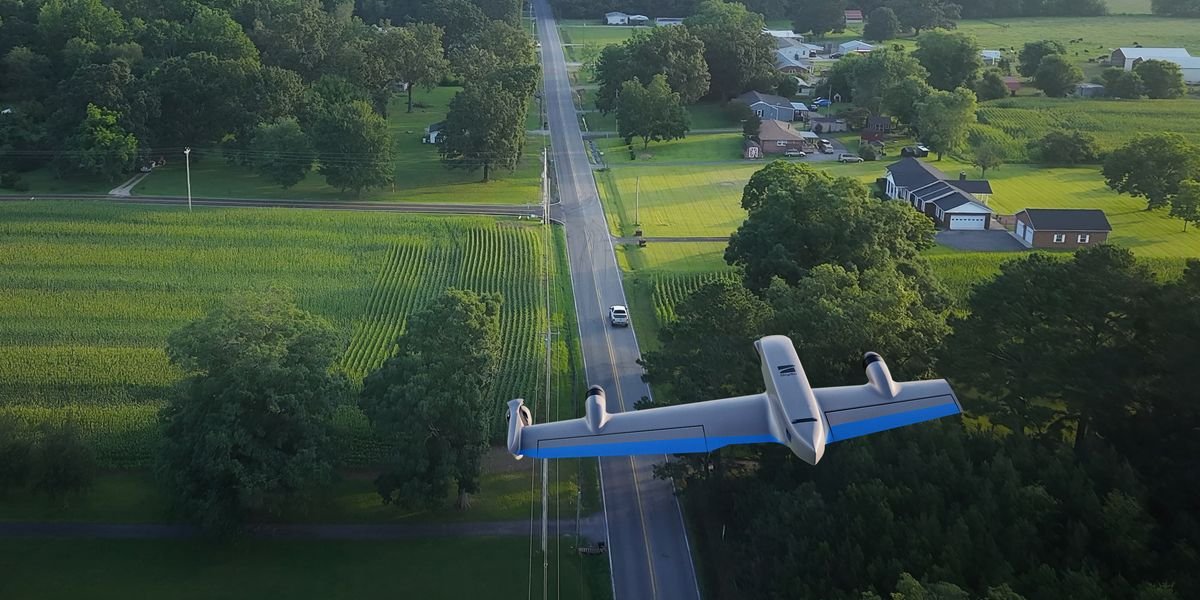
Even so, a new drone from Skydio is worth paying attention to, especially when it’s as weird as this one—the F10 Lightrunner is a fixed-wing camera drone designed for autonomous deployment and high-speed flight, all while looking so lopsided that it’s surprising that it can actually fly.
The benefits of asymmetrical aircraft
There’s a short rabbit hole you can go down if you start looking for other examples of asymmetrical aircraft. In the 1990s, legendary aircraft designer Burt Rutan and his company Scaled Composites built some decidedly odd airplanes, including the Model 202 Boomerang. But perhaps the most famous asymmetrical aircraft was the Blohm & Voss BV 141, a World War 2-era reconnaissance plane that featured an engine in the middle alongside a crew compartment alarmingly offset out onto the right wing. The unique design was intended to give the crew the best possible view for reconnaissance missions, because in a typical single-engine aircraft, the crew sits right behind the engine, limiting forward visibility.
Nearly 90 years later, the Skydio F10 is applying a similar philosophy to fixed-wing reconnaissance drones, which typically track targets by flying around them in circles. “While turning at low altitudes, it becomes very hard to avoid occluding a camera with a wing or a tail,” explains Andrew Goessling, director of engineering at Skydio. “So we were analyzing a lot of these use cases, and one of our engineers just blurted out, ‘what if we put the camera on the wingtip?’ And that’s where it all started, because as long as you only turn left, a lot of these problems just go away.”
Of course, putting the camera on the F10’s wingtip creates a bunch of new problems, chief among them that the aircraft is no longer balanced. Not only is the camera payload fairly heavy relative to the total mass of the drone, but its bulk also creates greater drag. This is why the seemingly straightforward solution of putting something else (like a battery) on the other wingtip to rebalance the drone isn’t practical, says Goessling. “The issue there is that the camera represents a substantial portion of the total aircraft drag, so putting something else on the other wing would cut your flight time nearly in half.”
 The F10’s wing-mounted camera payload necessitated asymmetrical wings and uneven motor placement.Skydio
Goessling points out that there’s nothing inherently bad about an asymmetric design like the F10; it just makes the life of engineers either a little more difficult or a little more exciting, depending on your perspective. “There were really two challenges here: What is the optimal design for an aircraft with a wingtip camera, and then once you have the design, how are you going to control it?”
Any fixed-wing aircraft design has to consider three factors: distribution of mass, how thrust is distributed between the motors, and how the shape and location of the wings affect the aircraft’s aerodynamics. Once Skydio decided on their requirements for the F10—including the wingtip camera, two motors to enable controllable hovering for takeoff and landing, and a high top speed and long flight time—the engineers used a modeling and optimization approach to explore design options. The resulting aircraft compensates for the wing-mounted camera payload by extending just that wing to provide more lift on that side, and repositioning the motors asymmetrically to balance thrust against the added drag of the camera.
Maneuvering with MegaDock
 The MegaDock can autonomously launch, recover, and recharge up to five F10 drones using a robot arm to grab them out of the air.Skydio
An added challenge was getting the F10 to launch and recover with a robot arm, using a storage, charging, and deployment system called the MegaDock. That requires the drone to transition from hover to forward flight and then back again—a particularly difficult trick for a flying wing with no tail control surfaces (movable parts of the wing used to steer the aircraft). The F10 uses model predictive control (a control technique based on a detailed physics model of the robot) to accomplish this autonomously, and a single control policy can handle the robot all the way through its entire flight envelope, from a stationary hover to its maximum flight speed of 100 miles per hour. In other words, there’s no “hover mode” or “flight mode,” so the mission planner just tells the drone where it needs to be, and the drone will know how to get itself there.
In operation, Skydio’s MegaDock can handle up to five F10s, allowing for continuous flight operations with three drones while two recharge. The entire system is fully autonomous, with humans only needed for remote supervisory control, communicating with the F10 via dual 5G cellular modems. Maximum flight time is two hours, and the aircraft is equipped with the same kind of magical obstacle-dodging camera setup as Skydio’s quadrotor drones. If something goes seriously wrong, an integrated parachute in the F10’s butt will deploy, lowering the drone to the ground gently enough that it’s safe to fly over people.
Goessling is the first to acknowledge that the F10 Lightrunner is an unconventional design, but he’s proud of what he and his team have come up with as a commercially viable solution to the occlusion issue with other fixed-wing drones. “It looks weird, and we got some pushback from some of the less technical parts of the company,” Goessling says. “If there were less crazy ways of doing it, we would have pursued them. But we have the data. We have sound reasons for every decision we’ve made. And the outcome at the end was well worth it.”
From Your Site Articles
Related Articles Around the Web
