

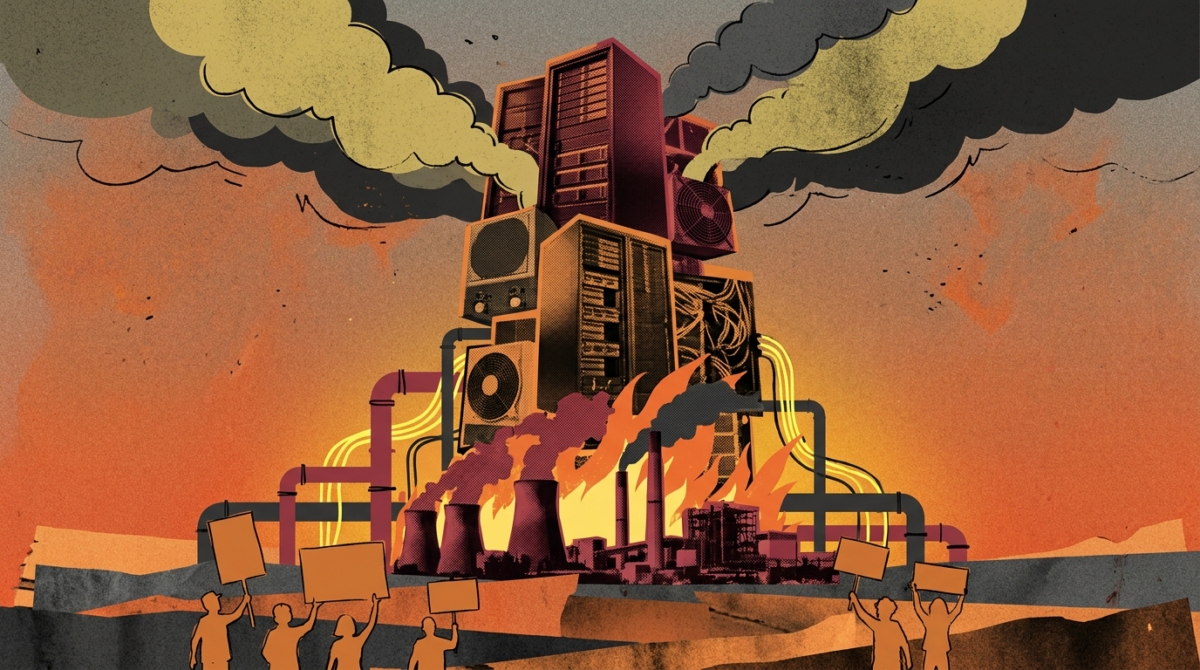
The roughly 400 largest data centers in the United States produced about as much CO2 through their electricity consumption in a single year as all of Denmark, or more, even before the current AI infrastructure boom could hit full force.
That is the finding of a Harvard University study published in Nature Sustainability, one of the first facility-level estimates of power consumption and CO2 emissions from so-called hyperscale data centers.
The research team led by Gianluca Guidi and Francesca Dominici used satellite imagery to identify 403 large-scale facilities and matched their estimated power demand between May 2024 and April 2025 with emissions data from regional grids. Depending on the assumed utilization rate, annual consumption ranged from 68 to 99 terawatt-hours, with the upper estimate on par with the electricity use of entire US states such as Indiana, Michigan, or Tennessee. Under the study’s central scenario, the facilities consumed about 82 terawatt-hours, roughly 1.8 percent of total US electricity use. More than half of that power was used in just four states, Virginia, Oregon, Ohio, and Iowa.
Some of the facilities sit in regions with relatively carbon-intensive power mixes and high shares of coal generation. Overall, about 54 percent of the electricity generated for the surveyed data centers came from fossil sources, primarily natural gas at 38 percent and coal at 15 percent. Under the Harvard study’s central scenario, that translated to about 25.7 million metric tons of CO2 per year. According to co-author Dominici, that figure matches or exceeds the annual greenhouse gas emissions of a US state like Michigan or a smaller European country such as Denmark. The emissions are also two to three times what an earlier comparable estimate found for 2018.
The researchers say the study only captures a snapshot, however, since the observation period ended in April 2025 and the enormous energy consumption of modern AI agents has been pushing demand even higher since then. Between 2022 and 2025 alone, power consumption at the largest tech companies rose by 240 percent, causing them to miss their own climate targets, according to a report by Climate Action Against Disinformation cited by the Associated Press.
With 2,000 more data centers planned across the US, co-author Dominici warns of a setback in efforts to curb CO2 emissions. Fossil-heavy power sourcing can also raise regional levels of air pollutants such as particulate matter, nitrogen oxides, and sulfur dioxide, which are linked to heart and lung disease and premature death. The study did not calculate specific health effects, though.
IEA warns of natural gas trend and strained power grids
The International Energy Agency’s (IEA) advance report Powering Artificial Intelligence also warns of growing strain on power grids and the climate. Hyperscalers are investing more than $700 billion worldwide in 2026 alone, mostly in new data centers, according to the report. In its central scenario, the IEA projects annual global CO2 emissions from data centers will rise from about 150 million metric tons of CO2 today to roughly 350 million metric tons per year by 2035. The upward revision stems largely from US operators increasingly investing in on-site natural gas power plants to bypass long waits for grid connections. Nearly 40 percent of identified AI data center capacity is also located in areas with high or extreme water stress.
The expansion is pushing local grids to their limits. In regions including Texas, Virginia, Finland, and the United Kingdom, applications in grid interconnection queues already exceed current peak load. According to the IEA, nearly 40 percent of the 134 grid integration regulations tracked worldwide were introduced in just the past 12 months.
To shield households from rising electricity prices driven by grid expansion and to weed out speculative applications, regulators are weighing measures that vary by jurisdiction, including minimum payment commitments, collateral, exit fees, flexible grid connections, and in some cases requirements for on-site firm power generation (“bring-your-own-power”). Actively throttling compute loads remains expensive for operators, though, since leasing AI capacity costs $20 billion to $30 billion per gigawatt per year, roughly 100 times as much as comparable battery storage capacity.
Voluntary AI climate pledge at COP31
Growing criticism of the AI industry’s resource consumption, which has already sparked local protests against new sites in the US and political backlash in recent elections, has now reached the United Nations. At the COP31 UN climate conference in Turkey, the International Telecommunication Union (ITU) and the host presidency introduced the “Antalya Artificial Intelligence Pledge” on Monday, addressing the 50 percent rise in AI data center power consumption in 2025.
The declaration calls on governments and companies to increasingly power AI infrastructure with zero- and low-emission energy, improve water and energy efficiency, disclose environmental impacts using standardized methods, reuse and recycle hardware, and promote AI solutions for climate action in developing countries. Separately from the pledge, experts at the conference are discussing the use of waste heat from data centers as another lever. According to the IEA, waste heat could supply district heating to about 10 percent of European households by 2030.
UN climate chief Simon Stiell warned sharply in Antalya against burdening people today with higher electricity bills and more pollution in exchange for vague promises of future AI efficiency gains. Advocates such as former US Vice President Al Gore hope AI can cut global emissions by 6 to 9 percent by 2030 through efficiency improvements, but the Antalya agreement is not legally binding. All transparency and power supply measures are voluntary and are set to be reviewed for the first time at COP32.
AI News Without the Hype – Curated by Humans
Subscribe to THE DECODER for ad-free reading, a weekly AI newsletter, our exclusive “AI Radar” frontier report six times a year, full archive access, and access to our comment section.
