

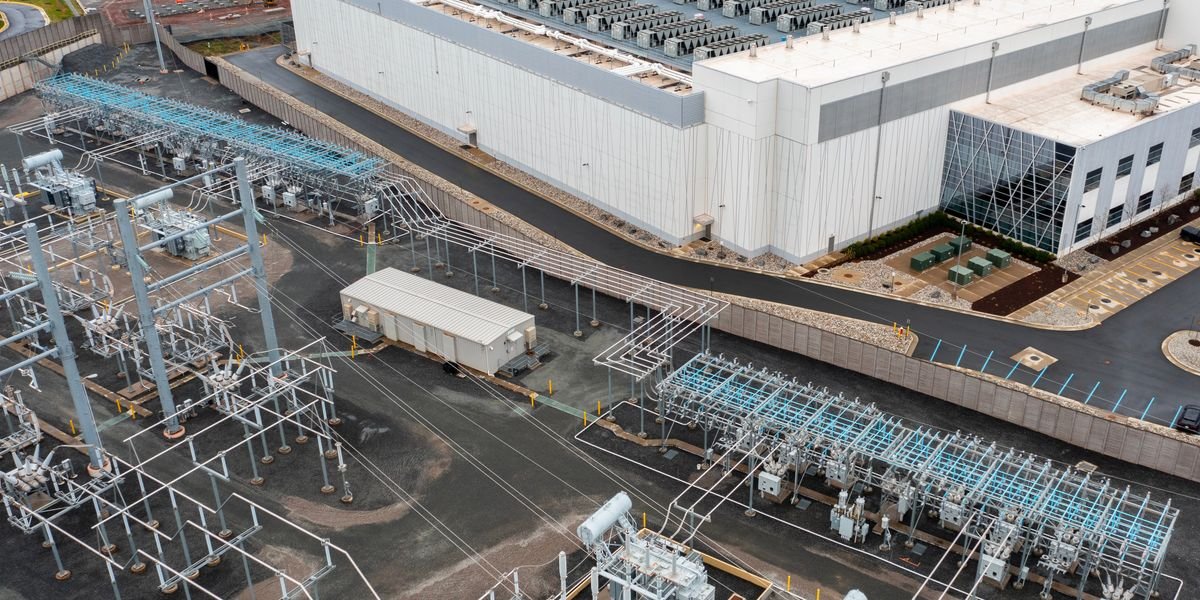
As the data centers powering the AI boom grow larger and more numerous, they pose increasing challenges to the grid. Single facilities can draw as much power as a large city and their demand can lurch by hundreds of megawatts in seconds, straining the power grid.
To rein in these wild electricity swings, U.S. regulators are beginning to write new rules. Their first step: Requiring data centers to disclose how their facilities interact with the grid, and just how wild their power swings are.
To that end, the North American Electric Reliability Corporation (NERC), an international regulatory authority, in October adopted its first reliability standards for computational loads. If approved by the U.S. Federal Energy Regulatory Commission (FERC), data center operators will have to disclose to grid operators and utilities how their facilities respond to faults and other glitches on the grid, record what happens during such events, and follow grid operators’ instructions on how much power to draw.
Data center operators have released little data on their facilities’ power profiles, making it difficult for researchers and regulators to quantify and address the problem. The disclosures will help regulators begin to standardize how data centers behave on the grid, and prevent blackouts and damage to grid infrastructure.
Data Centers Challenge Power Grids
Grid operators for decades have accommodated large, power-hungry facilities such as aluminum smelters. But the new grid citizens—data centers that are rapidly surpassing gigawatt scale—bring next-level complexity. Their highly variable power draw is a headache for grid operators, and their ever-increasing size and number greatly exacerbate the problem. “It’s just the sheer magnitude,” says Mark Lauby, chief engineer at NERC. “1,000 MW is the size of San Francisco, and that’s just one. How many San Franciscos are going to be built in [an] area?”
The growth is a concern because data centers have a tendency to cut themselves off from the grid at the slightest hint of a problem. On 22 July, Northern Virginia data centers drawing 3,800 MW of electricity abruptly disconnected after a routine transmission-line fault. The fault was quickly cleared but the facilities switched to backup power as a precaution, sending frequency and voltage spikes through the grid.
It wasn’t an isolated incident. In at least eight cases since 2022, data centers have abruptly shed between 200 and 1,800 MW of demand after grid faults, according to a draft NERC report that at press time had not been published.
The issue is happening because data center operators often use conservative settings on their protection systems. And because many facilities rely on the same underlying technology, they often react in unison, amplifying the impact, says Lauby. “That was okay when it was a 20 MW [facility],” he says. “But it’s not okay when it’s 1,000 MW, or if you’ve got fifty 20-MW [facilities] coming off at the same time.”
AI Training Brings Big Power Swings
Load loss is NERC’s primary focus for now, says Lauby. But every-day aspects of data center power management will also need addressing. GPUs can go from zero to full power in milliseconds, says Vassilis Kekatos, an associate professor of electrical and computer engineering at Purdue University. Across large facilities these GPU swings can be enormous. A 2025 NERC white paper showed a 50-MW section of a 200-MW data center ramping from 6 MW to 30 MW in a quarter of a second. Papers from both Meta and a collaboration between Microsoft, OpenAI and Nvidia have acknowledged rapid demand swings of tens to hundreds of megawatts.
The ramp rates can cause problems because generators such as coal, gas and other power plants may not respond quickly enough to such jumps, says Kekatos. That can cause major swings in grid frequency that could, in the worst cases, trigger outages. Operators plan for occasional jumps this size, says Kekatos, but data centers are making it routine.
Demand can also fluctuate rapidly, particularly when training large AI models, says Atri Bera, a senior member of technical staff at Sandia National Laboratories. Training is split across thousands of GPUs working in parallel and proceeds in steps, with power rising as each chip crunches a new batch of data and dropping as the chips pause to share results. Because the chips work in sync, servers can pulse from full power to near idle every few seconds, says Bera. In a recent paper, researchers at Dominion Energy, a utility serving Northern Virginia, found a 100-MW data center swinging by 10 to 15 MW every 2.5 seconds.
The fluctuations can also happen over multiple timescales, something Bera and collaborators at Sandia and Michigan State University recently modeled. Training often pauses every 10 or 20 minutes to save progress, leaving servers idle for up to a few minutes before ramping back up. Facilities typically run multiple jobs at once, and the ever-shifting schedule of runs starting and stopping can cause slower but much larger swings in overall demand.
The rapid fluctuations seen during model training can also cause problems when their rhythm lines up with a grid’s “natural frequencies,” says Gustavo Valverde, a senior scientist in ETH Zurich’s Power Systems Laboratory. When there’s a grid disturbance, such as a line tripping or a power plant disconnecting, nearby generators will briefly speed up or slow down compared to more distant ones. This causes the power flowing along the lines between them to temporarily rise and fall. The rhythms of these fluctuations, which are determined by the grid’s layout, equipment and operating characteristics, are known as natural frequencies.
Normally, these fluctuations eventually die out, but in recent simulations, Valverde showed that when data centers’ pulsing resonates with these natural frequencies, the power fluctuations grow much larger. He likens it to pushing a child on a swing in time with its motion, sending it ever higher. The result can be wear and tear on grid equipment, disconnecting of generators, and blackouts.
NERC Says Data Centers Must Share Power Data
Quantifying the impact of data centers’ unique power use has been difficult due to the dearth of information coming from data centers. Valverde says operators have refused to share information with him about their facilities’ power use, leaving him to scrounge power profiles from presentation slides he found online. “I’ve tried with the different data center owners, and they say that this is confidential,” he says. “I guess because the topic is controversial, they don’t want to share.”
This paucity of data is why NERC’s new rules focus heavily on data sharing. “We need information from these data centers to be able to model and study them,” says Latrice Harkness, director of engineering at NERC.
Under NERC’s standards, facilities with at least 50 MW of computing load connected at 100 kV or above must provide detailed, up-to-date models of how they draw power and react to grid problems, including their settings for tripping offline. They must also share real-time operating data, follow grid operators’ instructions to reduce or maintain demand, ensure their protection systems work in step with those operated by the utility, and install recorders that capture what happens during disturbances.
NERC also created a roadmap for developing further rules limiting how these facilities draw power. Those will include standards for when data centers must stay connected, or “ride through,” disturbances. Next year, NERC plans to set criteria to prevent the kind of forced oscillations Valverde studied.
How operators meet the standards is up to them, Harkness says. Companies are experimenting with ways to adjust the characteristics of their AI workloads to smooth power demand and systems that serve as a buffer between the data center and the grid. Valverde is confident data center operators will figure it out. “They have the money,” he says.
From Your Site Articles
Related Articles Around the Web
