

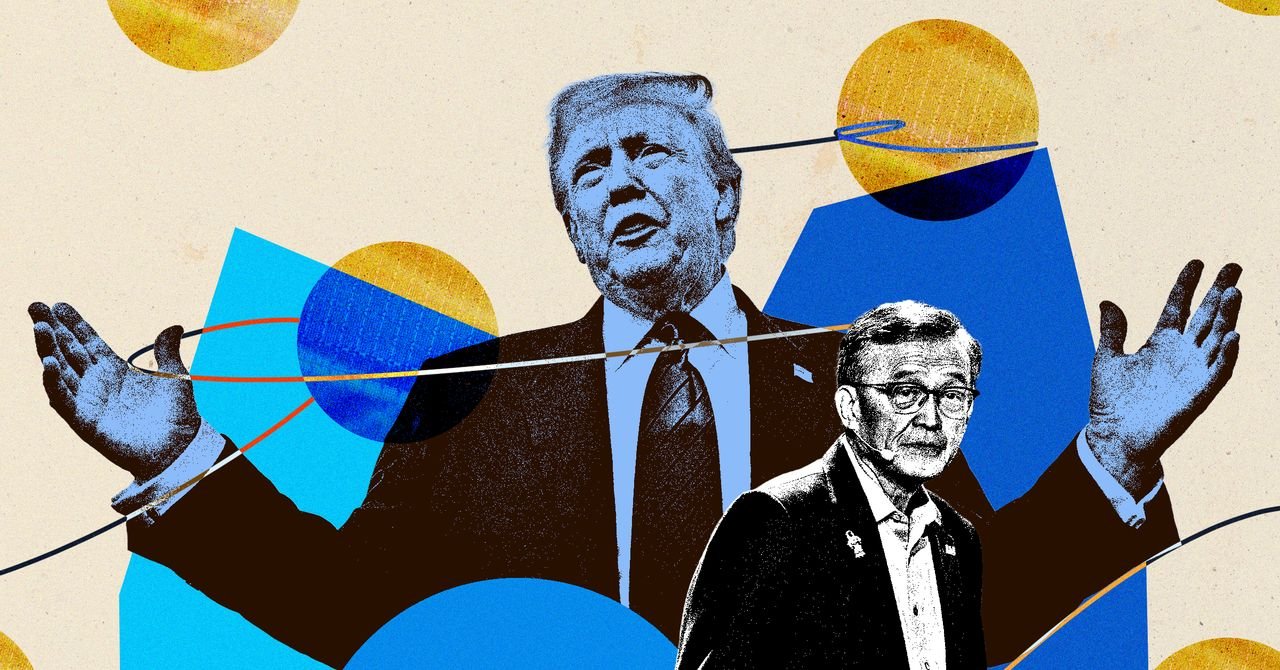
On August 25, Lutnick released a video with Tan, sitting side-by-side on cushioned chairs. “I really look forward to have the US government be my shareholder,” Tan turned to Lutnick and said. “And we can work together and make Intel great again.”
Inside the company, the video was “a surprise to everyone,” according to a source with direct knowledge of the matter. Some employees joked that it was reminiscent of a “hostage video.”
Not long after that, Nvidia—led by Tan’s friend Jensen Huang—made a $5 billion investment in Intel. “I love seeing their stock price go up, making the USA RICHER, AND RICHER,” Trump posted. “Who would not want to make deals like that?”
Deals, plural. On the day Tan was hauled to the Oval Office, Trump announced that his administration had been negotiating separately with Huang. The Nvidia leader was beyond eager to sell more of his semiconductors to China. “And I said, if I’m going to do that, I want you to pay us as a country something,’” Trump said. They settled on 15 percent of all sales of the H20 model chip. Months after that, they cut a second deal: a 25 percent bounty on sales of Nvidia’s even-more advanced H200 chips.
In their lawsuit against Nvidia, Paisner’s attorneys argue the surcharges amount to “unlawful taxes,” and that the board’s “decisions to enter into such agreements are the product of mismanagement and breaches of fiduciary duty.”
In court, NVIDIA’s lawyers insisted that the company “did not enter into any illegal ‘agreement’ with the government but instead engaged with the government and stated that it would comply with federal regulations.” Moreover, the attorneys say Paisner is trying to make a political point, rather than a legal one. “When asked about his purpose in bringing this action,” they write, “Paisner was candid: ‘It’s to make a public point of how NVIDIA conducts itself.’”
The attorneys wrote this in May, months before Nvidia’s and Huang’s recent drama. Last week, board chair Harvey Jones said on the company’s quarterly earnings call that it did “not intend to reinstate Jensen as CEO,” citing his “disclosure of personal behavior inconsistent with the company’s code of conduct, standards, and cultural norms.” (Not to mention mounting evidence that the company’s most sophisticated chips were making their way to China, in violation of US law.) But, according to The New York Times, after days of pressure from top administration officials, the company and the government essentially struck a deal Sunday night to reinstate Huang.
“Don’t think for a second that politics ever play a role in this company, not even a little bit,” Huang said during his first company-wide meeting after rejoining the company, WIRED reported. “We are the most apolitical company. I don’t love that we talk about politics here. Take it home. I love that we talk about work here.”
Additional reporting by Lauren Goode.
