

Flashing lights and beeping tones may slow Alzheimer’s disease—but only if treatment starts early enough. That’s the upshot of the largest test yet of the idea that syncing brain activity to 40 hertz (Hz), or 40 cycles per second, can blunt the ravages of dementia.
An hour a day of rhythmic light and sound, delivered through a wearable device from Cognito Therapeutics, curbed cognitive decline in people still early in their illness, researchers reported Monday at the Clinical Trials on Alzheimer’s Disease conference in Boston.
The benefits were biggest among those who stuck with the sessions on most days. In that group, the loss of everyday skills slowed by more than 80 percent on one standard measure, and on another, thinking ability held steady.
Among people with more advanced disease, however, the 40-Hz strobe-and-sound therapy offered little benefit. And across the trial population as a whole the difference between the treatment and sham groups was not statistically significant. The data weren’t strong enough to rule out chance as an explanation.
To some leading Alzheimer’s researchers, that’s the only result that matters. “It’s simply negative,” says Paul Aisen, a neurologist who directs the Alzheimer’s Therapeutic Research Institute at the University of Southern California. Any positive findings in slices of the data, he says, are merely “exploratory.”
But Cognito CEO Christian Howell notes that regulatory authorities judge devices by a different yardstick than drugs, placing more weight on whether a product’s benefits outweigh its risks than on hitting a single statistical target—especially for low-risk technologies like the company’s Spectris headset. And despite the mixed results, he remains confident that the U.S. Food and Drug Administration (FDA) will authorize the device for people with mild Alzheimer’s. Howell says the company is on track to file for authorization by mid-2027, which could bring a decision before the end of the year.
And whatever regulators decide, for the scientists who first showed a decade ago that a 40-Hz flicker could reduce Alzheimer’s-linked plaques in the brains of mice, even the partial win is a long-awaited payoff. “It’s a dream come true,” says Li-Huei Tsai, the MIT neuroscientist who led that work and, together with MIT neuroengineer Ed Boyden, cofounded Cognito in 2016.
How 40-Hz Stimulation Works
That dream began with a pulsating light. In their initial report, the MIT researchers showed that an hour of LEDs blinking at 40 Hz caused neurons in the visual cortex of mice to synchronize their firing at the same frequency, within the range of brainwave frequencies known as the gamma band. Later studies added sound to drive the rhythm in the hippocampus, a memory hub, as well.
 MIT neuroscientist Li-Huei Tsai first showed in mice that a 40-Hz flicker could reduce Alzheimer’s-linked plaques. Her lab built this prototype light-and-sound device to test the idea in people.MIT Picower Institute for Learning and Memory
Such gamma rhythms—fast, coordinated brain waves tied to attention and memory—falter early in Alzheimer’s disease. The 40-Hz stimulation acts like a metronome for the brain, imposing a steady tempo that, as a decade of follow-up work from Tsai and her colleagues showed, can help clear toxic amyloid protein, protect neurons and their connections, and speed the flushing of waste from the brain, at least in mice.
By 2018, Cognito had advanced the strategy into human testing. A string of small clinical trials showed that the stimulation was safe and could drive the desired rhythms. Side effects were limited to occasional headaches or ringing in the ears. And unlike the antibody drugs now approved for the disease, the device brought with it no risk of brain swelling or bleeding. But none of those initial trials was big or long enough to show whether the treatment slowed the disease.
Cognito’s HOPE study—a yearlong, sham-controlled trial involving 673 people with mild-to-moderate Alzheimer’s—was built to find out.
Cognito Trial Suggests Benefits in Mild Alzheimer’s
Across the whole population of trial participants, those who received the real treatment, tuned to the maximum brightness and volume each person could tolerate, did not fare significantly better than their counterparts given a look-alike device programmed with non-therapeutic settings.
But the picture changed when researchers looked at just the 395 participants with mild disease. After a year of treatment, participants using the real device showed about half as much decline as their sham-treated peers on a standard clinical scale that rates memory, judgment, and daily functioning. And on a composite measure built around what patients and caregivers say matters most to them—from thinking clearly to living independently—decline slowed by nearly two-thirds.
“There seems to be a pervasive signal in the mild group,” says Michelle Papka, a neuropsychologist who contributed to the study and sits on Cognito’s medical advisory board. That fits a broader pattern seen with drug therapies for Alzheimer’s, which tend to work best in people whose disease is least advanced, before the brain has sustained too much damage. “The earlier we can get to people, the better chance we have of modifying the disease,” Papka says.
Adherence Question Complicates Cognito Trial Results
Digging deeper into the data, Cognito saw that the more faithfully people used its device, the bigger the payoff.
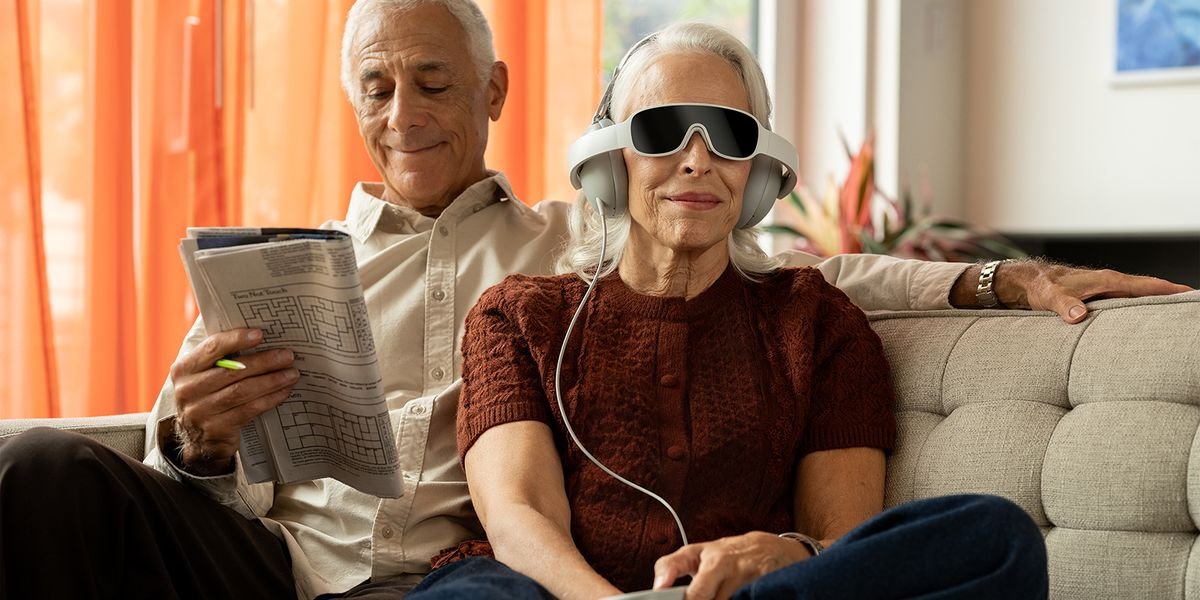
Among mild-stage participants who stuck to the treatment protocol—sitting on the sofa or at the kitchen table and donning the device’s glasses and headphones for a full hour on at least 70 percent of days—decline on the clinical rating scale slowed even further, while everyday skills and thinking ability held up markedly better.
That pattern convinces Annabelle Singer, a neuroscientist at Georgia Tech, that the device itself is driving the benefit. “It’s quite telling that if you adhere, you get the clear effect, but if you’re not really completing the assignment, you’re not getting the effect,” says Singer, who contributed to the early MIT research as a postdoc in Boyden’s lab and now serves on Cognito’s scientific advisory board. “That, to me, is compelling [evidence] that it’s the therapy, not a placebo effect or something else,” she says.
“The earlier we can get to people, the better chance we have of modifying the disease.”—Michelle Papka, neuropsychologist
Others, however, are more cautious. Fewer than half of the mild-stage volunteers met that adherence threshold, and analyses limited to people who follow instructions can mislead—because those who stick with a treatment may differ in important ways from those who don’t.
Trials of other devices that people struggle to use consistently, such as CPAP machines for sleep apnea, have tackled this problem with a run-in period. Only volunteers who prove they’ll actually use the device during an initial tryout phase make the cut for the main study, and only their results count in the final analysis.
According to Daniel Gillen, a statistician at the University of California, Irvine, who specializes in Alzheimer’s clinical trial design, that kind of setup allows for “a genuine unbiased comparison among compliers,” something the HOPE trial wasn’t designed to provide. For that reason, he says, Cognito’s adherence findings are best seen as a promising signal rather than definitive proof that the headset slows mild Alzheimer’s.
Making 40-Hz Light Therapy Easier to Use
Even if the benefit is real, the low adherence points to a practical hurdle: getting people with Alzheimer’s to sit through an hour of flicker every day.
“Compliance is a big issue,” says Mariana Figueiro, a photobiologist who directs the Light and Health Research Center at the Icahn School of Medicine at Mount Sinai in New York City. She has spent years testing light-based therapies for people with dementia in nursing homes and assisted living facilities. Drawing on that experience, “I do have serious concerns about the feasibility of this thing,” she says of the Cognito system.
Figueiro says the Cognito study is a valuable first-generation demonstration of what 40-Hz stimulation might achieve. But to reach the millions of people living with early Alzheimer’s, she says, “we probably ought to find a better way to deliver these things.”
Several groups are trying to do just that. A company called OptoCeutics has a 40-Hz therapy lamp that alternates between two colors of flickering light, which the eye blends into a steady white stream. (In January, Cognito and MIT sued OptoCeutics in federal court, alleging patent infringement; Mai Nguyen, CEO of OptoCeutics, says it is “very early in the cases” and that the company is “confident in our positions.”)
OptoCeutics claims that users find its platform more comfortable than a typical 40-Hz flicker—though whether it drives brain rhythms as effectively, or does anything to slow Alzheimer’s disease, remains unclear. A six-month, sham-controlled trial in Denmark is ongoing.
Low adherence points to a practical hurdle: getting people with Alzheimer’s to sit through an hour of flicker every day.
Others are sticking with headsets but redesigning them for everyday wear. In South Korea, for example, engineers have built glasses fitted with transparent OLED displays that strobe at 40 Hz while letting wearers see their surroundings. In principle, people could then soak up the stimulation while going about their daily activities, rather than having to sit behind opaque goggles as the Cognito device requires.
As for Cognito, the company is already tinkering with see-through lenses for a potential Spectris 2.0, Howell says. But first, it hopes to use the existing results to pursue FDA approval for the current, opaque, goggle-style design, covering only people with mild Alzheimer’s. The benefit in that group is “massive,” he says. And with few side effects to weigh against it, he flips the usual regulatory question on its head: “What is the risk of not providing this to patients?”
Consumer 40-Hz Therapy Devices Are Already for Sale
Many would-be customers aren’t waiting for the FDA to weigh in. A quick search for “40 Hz therapy” turns up a sprawling marketplace of light boxes, headbands, and other consumer gizmos pitched at people worried about memory loss.
OptoCeutics itself sells its ‘Evy’ lamp for $2,999 as a “general wellness” product, with a disclaimer that it isn’t a medical device. Another company called Vielight offers a $1,799 headset with a nose clip that beams 40-Hz pulses of near-infrared light through the scalp and up the nostrils. Lower-tech alternatives can be found for much less.
Even Georgia Tech’s Singer can’t escape the sales pitch. Thanks to her research, and the search history that comes with it, she now regularly gets targeted advertisements for 40-Hz gadgets. The problem with most of these devices, she says, is simple: “We don’t know what they’re doing.”
Her advice to anyone tempted to click ‘buy’? “Be a sophisticated consumer,” she says. “You always want to test and make sure that it’s delivering the stimuli it’s supposed to.”
How One Patient Built a DIY 40-Hz Device
That’s easier said than done. Few people have the gear or the know-how to check whether a lamp or speaker really blinks or buzzes at a 40-Hz beat.
Jay is an exception. Alzheimer’s runs in his family, and when his own memory began to slip in his 50s, the retired electrical engineer from southern New Hampshire started looking for ways to fight back. Jay, who asked to be identified only by his first name to protect his privacy, heard about Tsai’s flickering-light experiments on public radio and soon after built his own 40-Hz device. He took a pair of dark wraparound sunglasses, fitted them with a strip of LEDs and wired them to a 555 timer, a cheap, decades-old chip that hobbyists use to make Christmas lights blink at a set rate.
For anyone with a little electronics savvy, says Jay, “it’s not very complicated at all.”
Later, after being diagnosed with early Alzheimer’s, Jay enrolled in the HOPE trial. He spent his first year using what he suspects was the sham headset, then switched to the real thing for a second year as part of a follow-on study in which every participant got active treatment. With the Spectris device still unavailable outside of research, he has since gone back to his homemade rig.
Every morning, after coffee and a French lesson on Duolingo, he settles onto his loveseat for another session. “It’s a little bit boring,” admits Jay, now 67. But he takes the HOPE results as a sign that the tedium is worth it. “My family has been decimated by Alzheimer’s,” he says, “so I’m glad to be able to have some means of getting control over it.”
And the year he thinks he spent with a dud, even though there is now evidence that the therapy works against the kind of mild Alzheimer’s he has? No regrets. “I’m willing to take one on the chin a little bit in order to help other people.”
From Your Site Articles
Related Articles Around the Web
