

Today’s connected vehicles collect and transmit far more personal data from drivers and passengers than their predecessors, with costly consequences. The Center for Automotive Management in Germany estimates that cyberattacks have caused more than $20 billion in damage to the auto industry as of 2025, twenty times higher than in 2022. This week, engineers and cybersecurity researchers are gathering in Bonn, Germany, for the Embedded Security in Cars (escar) conference to discuss using AI for defense, hardening chips, and otherwise securing the auto industry’s data handling.
Frank Kargl, an escar Europe co-organizer and director of the Institute of Distributed Systems at Ulm University in Germany, says that recent cyberattacks on infrastructure like supermarket refrigerators all over Europe have highlighted the risk of a broad hack of automobiles that aims to cause arbitrary damage. Kargl says the risk for a regular driver being singled out for hacking is still low, but, “I think we still need to consider the case of large-scale attacks affecting massive numbers of vehicles and be prepared for this.”
Lightweight data monitoring and firewalls to secure vehicle data
Safeguarding a modern vehicle is no easy task. Cameras, microphones, GPS trackers and other sensors capture a great deal of personal information, ranging from a person’s private conversations to their daily travel habits. That data is beamed across communications networks to data centers. Automakers sell some data to third-party companies. Each link is subject to cyberattack, and each software update could let in a new vulnerability.
In response, engineers are developing adaptive, AI-enabled software defenses, building more-secure automotive chips, and battening down the entire network of infrastructure, ranging from aftermarket accessories to electric-vehicle charging stations. Kargl says that engineers are also working on migrating automobile cryptography to post-quantum algorithms, because sooner or later quantum computers will be able to break traditional encryption methods.
Computer scientist Olaf Landsiedel, of the Institute for Networked Cyber Physical Systems at Hamburg University of Technology in Germany, is giving a keynote at the escar conference about adaptive AI for automotives. He says that the future of auto cybersecurity will be lightweight systems that continuously monitor a vehicle’s communication in the background, pulling in a sophisticated AI model activated when suspicious behavior is observed. “This could provide more comprehensive monitoring without continuously consuming significant computational resources,” he says, which is necessary because cars have limited onboard computing power and energy. Landsiedel and colleagues have developed a deep-learning model they call “ThinkingViT” that uses a nested progressive inference process to minimize the compute needed to accomplish image-recognition tasks.
Detroit auto cybersecurity firm Block Harbor, is borrowing design principles from enterprise IT, as they seek to protect increasingly data-heavy cars, says COO Andre Weimerskirch. This involves a “defense-in-depth” approach, with multiple layers of security, with the assumption that any single security barrier could be breached, he says. Block Harbor is also using AI to help scan for vulnerabilities.
Fleet operators face their own challenges: They must secure vehicles they didn’t design or manufacture. In Norway, public transport operator Ruter announced in 2025 that it is developing firewalls to help protect its bus fleet. It had discovered that the software on buses made by China’s Yutong could be updated remotely, with the theoretical risk that an adversary could shut down the vehicles. Ruter acknowledged at the time that it would need to remain vigilant, as the next generation of buses is set to be “more integrated and harder to secure.”
Landsiedel says the fleet operators must consider not only the vehicles themselves, but also all the infrastructure they interact with, as well as the central fleet-management system. “Every connection creates potential vulnerabilities,” he says, which means fleet operators should consider “end-to-end security, including authenticated communication, access control, and the protection of cloud and edge infrastructure.”
 Automakers and their suppliers have been scrutinizing their supply chains to comply with U.S. Commerce Department restrictions on components and software from China and Russia.Harman
Some of these risks are hard to address through technical measures alone, especially in the face of nation-state-sponsored attacks. The U.S. Commerce Department has banned the import of Chinese and Russian connected vehicles starting with model year 2027, and is prohibiting automakers from using software and key components designed in those countries. Countries in Europe have also been mulling bans. “I feel the responsibility to defend against nation-state attackers is a shared responsibility between the vehicle manufacturer and the government,” Weimerskirch says.
Indeed, U.S. restrictions have influenced the design of Samsung Electronics subsidiary Harman Automotive’s global offerings, says Harman head of solution architecture and cybersecurity lead Monica Mitchell. “We don’t want to bifurcate our solutions,” she says.
Research, regulators, prosecutors rein in car data brokers
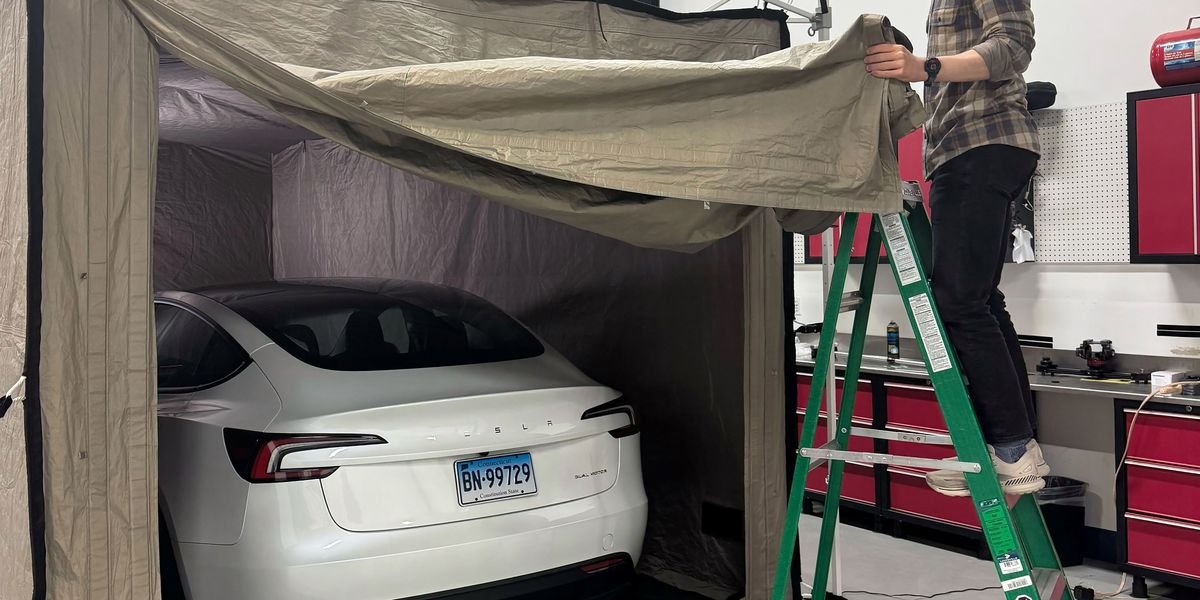
Researchers and regulators are also working to curb carmakers’ voluntary oversharing of data with third parties. At Northeastern University, a team of researchers recently announced the results of a study in which they captured the data traffic emitted from 19 car brands. They drove the cars into a Faraday tent to isolate the signals, and rerouted the cars’ internet traffic to networks the team controlled. The researchers found that cars were sending data to companies including Amazon, Google, Meta and Microsoft. They also found the cars’ companion apps were sending personal information like vehicle identification numbers (VINs), email addresses, and geolocation data.
Nicole Zagson, a doctoral candidate in cybersecurity at Northeastern and a coauthor of the study, says that privacy agreements for connected vehicles tend to be opaque, making it difficult for car owners to understand how their data is being shared. One automaker, Honda, took action in response to the research, asking an analytics vendor to delete drivers’ location information and VINs. “There’s not enough scrutiny on what they are putting into these vehicles, because it’s so hard to study,” Zagson says.
The U.S. Federal Trade Commission (FTC) and state prosecutors have taken action as well. In October, General Motors agreed to pay US $220 million to settle allegations brought by 36 attorneys general that it illegally sold consumers’ driving behavior and location information to data brokers, which resold it to insurance companies. GM finalized a settlement with the FTC over similar allegations in January.
While individual drivers have limited control over their car’s cybersecurity, Landsiedel says they can reduce their exposure by keeping software updated, using strong passwords and multi-factor authentication when available, and avoiding untrusted aftermarket devices.
From Your Site Articles
Related Articles Around the Web
