

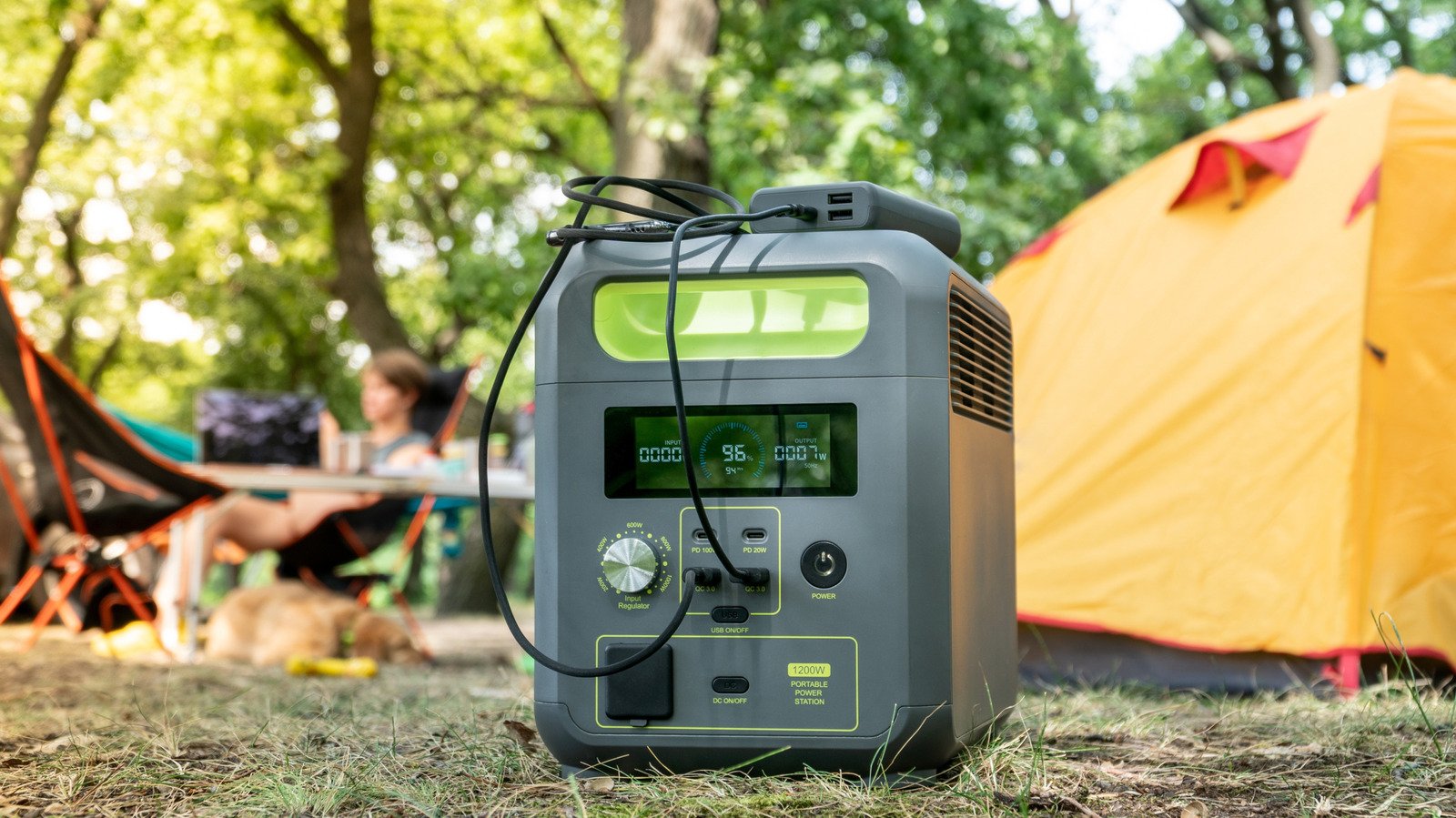
Determining the stamina of your portable power station is more complicated than you might expect.
This is anecdotal, perhaps, but based on the number of ads I’m bombarded with, it feels like portable power stations have become a hot commodity in the last several years. And it makes sense — in a society increasingly dependent on phones and laptops, not to mention other electronics, even the best small power banks just won’t cut it during a prolonged outage. And of course, these stations have always had uses outside the home, such as camping or job sites.
A critical question to ask is how much power you actually need. More isn’t always better, since a high-end station is not only expensive, but considerably larger and heavier. A multi-kilowatt station might cost as much or more than the devices it’s powering and require help to lift if you’ve been neglecting the gym.
Let’s take 1,000Wh (watt-hours) as a baseline. How long can you reasonably expect that to last when the power goes out at home or you’re watching YouTube in the Adirondacks? The answer is surprisingly complicated. It depends on what you plug in, how it’s actively operating, and how efficient your power station is at converting energy.
The real-world limits of a 1,000Wh power station
While there are plenty of options out there from brands like Anker and EcoFlow, let’s take the Jackery Explorer 1000 v2 as an example. It’s rated at 1,024Wh, and can deliver up to 1,500W of output. Simple math suggests that a 200W fridge, for example, could run for over five hours, or that a 65W laptop could last for well over 15 hours.
In practice, however, even Jackery only promises four hours for that fridge and 11 hours for the laptop. So what gives? The answer is power conversion. When you plug into a station’s AC outlet, that power has to be converted from DC, possibly wasting anywhere from 5 to 20 percent in the process. Total efficiency is impossible, and you might make things even less efficient if you plug in something like the wall adapter for your phone or tablet, which converts AC back to DC.
It’s also worth noting that the rated consumption for devices can vary wildly in practice. A gaming laptop might consume a few dozen watts when it’s browsing the web, but well over 200W when it’s running full tilt. Even your phone is going to have ebbs and flows, based on what it’s trying to do — it takes a lot more more juice to stream a TV show over 5G than it does to add those crackers to your calorie counter.
What you can do to stretch out a power station’s runtime
For a start, if a station has built-in USB ports, plug your phones, tablets and other mobile devices into those whenever possible. You’ll reduce the inefficiency created by plugging in adapters. Naturally, this also frees up AC outlets, allowing you to plug in other critical gear.
Pay attention to ambient temperatures, too. While something like the Jackery 1000 is rated for output at temperatures from 14 to 113F (-10 to 45C), the optimal range for its LiFePO4 (lithium iron phosphate) batteries is actually around 59 to 95F (15 to 35C). You’ll get less power out a battery that’s extremely cold or extremely hot, so simply keeping a station in the shade or properly ventilated could make a world of difference.
In the long term, consider the impact of charging cycles. There’s a difference between battery capacity and battery life, and as with any rechargeable battery device, the usable capacity of your portable power station shrinks over time, based largely on how many full cycles (or their equivalent) you’ve gone through. It may be hard to put a dent in something with a kilowatt-level supply, but that should be a reason to avoid draining a power station unless you really need it.
