

Open and reproducible datasets are essential for advancing good machine learning. At the same time, datasets have grown tremendously in size as rocket fuel for large language models. In 2020, Hugging Face launched 🤗 Datasets, a library dedicated to:
- Providing access to standardized datasets with a single line of code.
- Tools for rapidly and efficiently processing large-scale datasets.
Thanks to the community, we added hundreds of NLP datasets in many languages and dialects during the Datasets Sprint! 🤗 ❤️
But text datasets are just the beginning. Data is represented in richer formats like 🎵 audio, 📸 images, and even a combination of audio and text or image and text. Models trained on these datasets enable awesome applications like describing what is in an image or answering questions about an image.
The 🤗 Datasets team has been building tools and features to make working with these dataset types as simple as possible for the best developer experience. We added new documentation along the way to help you learn more about loading and processing audio and image datasets.
Quickstart
The Quickstart is one of the first places new users visit for a TLDR about a library’s features. That’s why we updated the Quickstart to include how you can use 🤗 Datasets to work with audio and image datasets. Choose a dataset modality you want to work with and see an end-to-end example of how to load and process the dataset to get it ready for training with either PyTorch or TensorFlow.
Also new in the Quickstart is the to_tf_dataset function which takes care of converting a dataset into a tf.data.Dataset like a mama bear taking care of her cubs. This means you don’t have to write any code to shuffle and load batches from your dataset to get it to play nicely with TensorFlow. Once you’ve converted your dataset into a tf.data.Dataset, you can train your model with the usual TensorFlow or Keras methods.
Check out the Quickstart today to learn how to work with different dataset modalities and try out the new to_tf_dataset function!
Dedicated guides
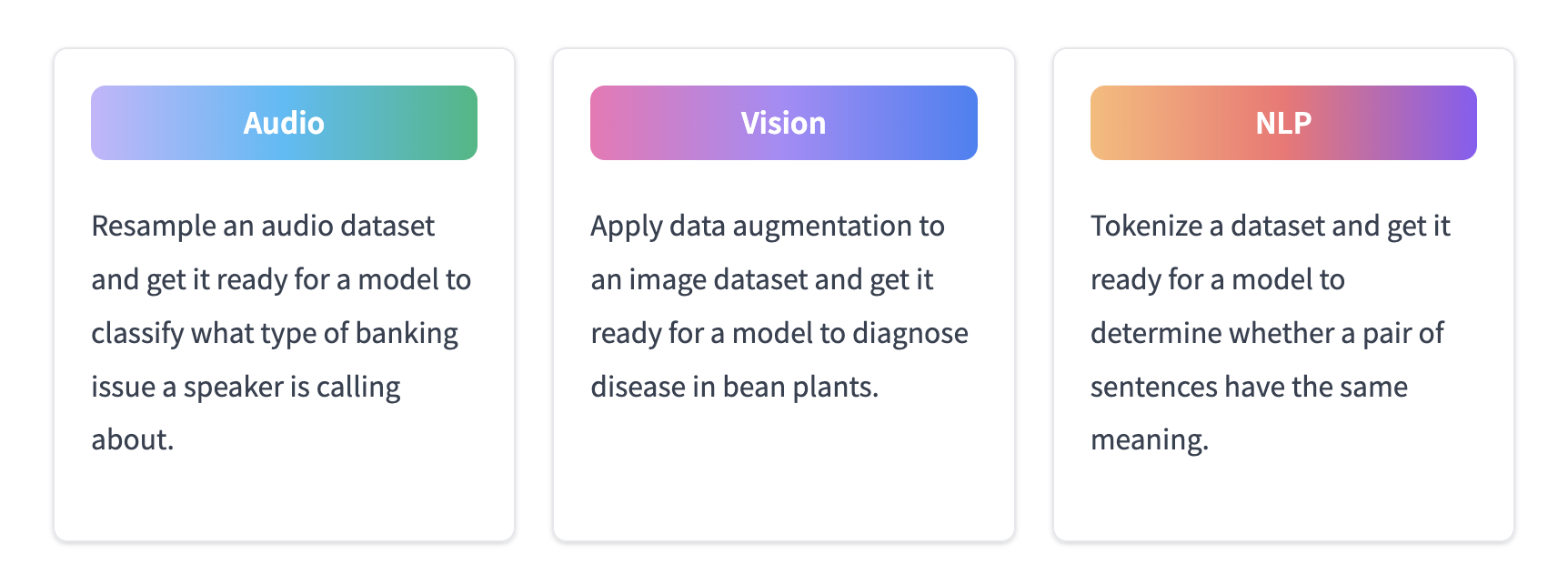
Each dataset modality has specific nuances on how to load and process them. For example, when you load an audio dataset, the audio signal is automatically decoded and resampled on-the-fly by the Audio feature. This is quite different from loading a text dataset!
To make all of the modality-specific documentation more discoverable, there are new dedicated sections with guides focused on showing you how to load and process each modality. If you’re looking for specific information about working with a dataset modality, take a look at these dedicated sections first. Meanwhile, functions that are non-specific and can be used broadly are documented in the General Usage section. Reorganizing the documentation in this way will allow us to better scale to other dataset types we plan to support in the future.
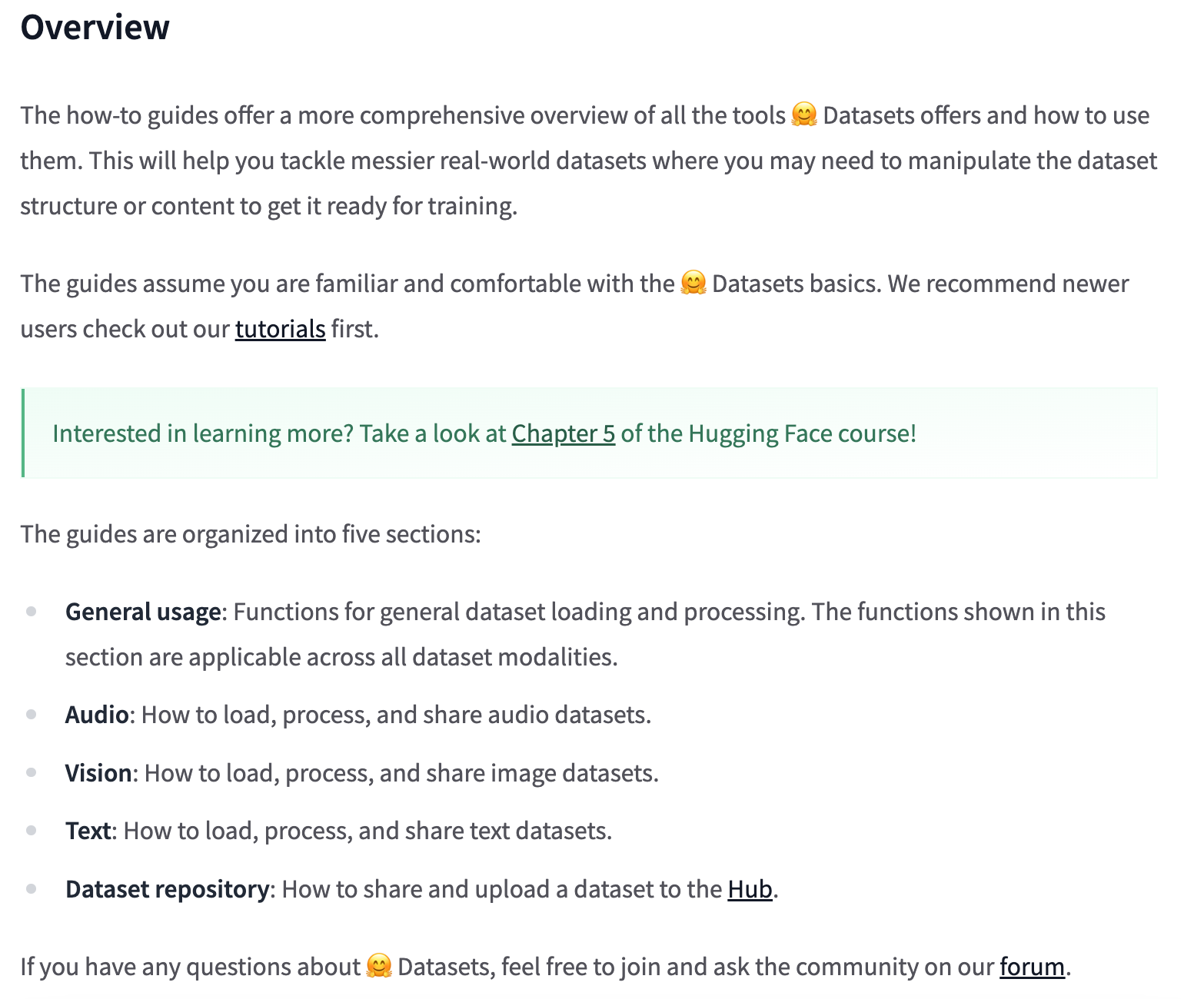
Check out the dedicated guides to learn more about loading and processing datasets for different modalities.
ImageFolder
Typically, 🤗 Datasets users write a dataset loading script to download and generate a dataset with the appropriate train and test splits. With the ImageFolder dataset builder, you don’t need to write any code to download and generate an image dataset. Loading an image dataset for image classification is as simple as ensuring your dataset is organized in a folder like:
folder/train/dog/golden_retriever.png
folder/train/dog/german_shepherd.png
folder/train/dog/chihuahua.png

folder/train/cat/maine_coon.png
folder/train/cat/bengal.png
folder/train/cat/birman.png
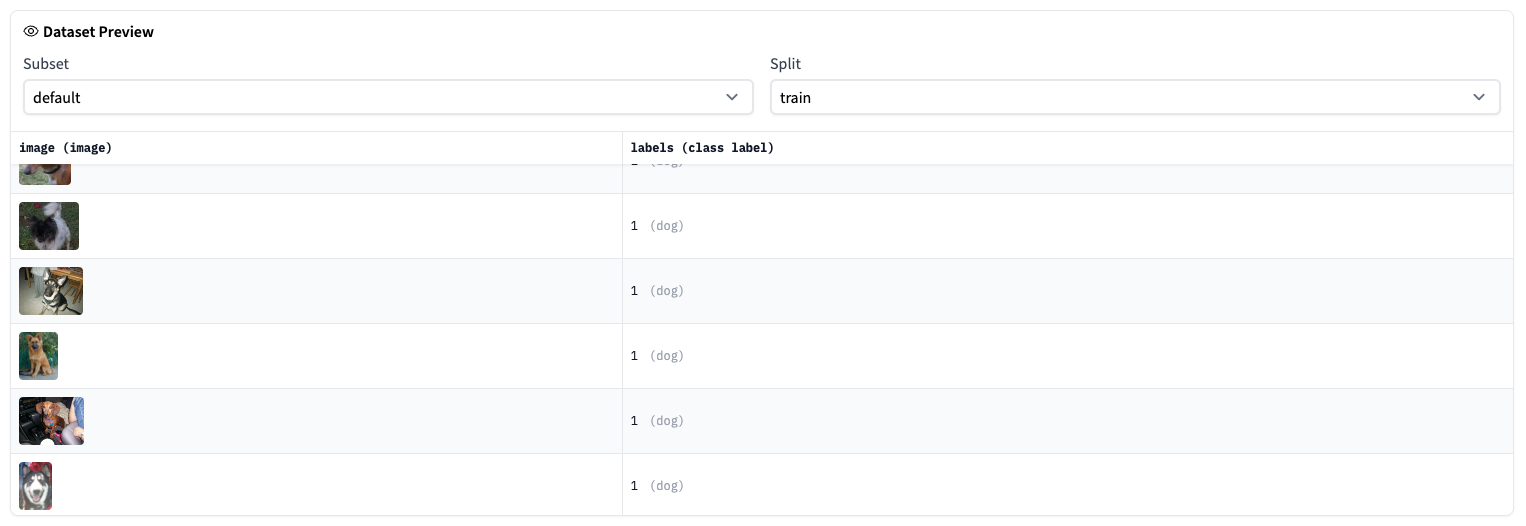
Image labels are generated in a label column based on the directory name. ImageFolder allows you to get started instantly with an image dataset, eliminating the time and effort required to write a dataset loading script.
But wait, it gets even better! If you have a file containing some metadata about your image dataset, ImageFolder can be used for other image tasks like image captioning and object detection. For example, object detection datasets commonly have bounding boxes, coordinates in an image that identify where an object is. ImageFolder can use this file to link the metadata about the bounding box and category for each image to the corresponding images in the folder:
{"file_name": "0001.png", "objects": {"bbox": [[302.0, 109.0, 73.0, 52.0]], "categories": [0]}}
{"file_name": "0002.png", "objects": {"bbox": [[810.0, 100.0, 57.0, 28.0]], "categories": [1]}}
{"file_name": "0003.png", "objects": {"bbox": [[160.0, 31.0, 248.0, 616.0], [741.0, 68.0, 202.0, 401.0]], "categories": [2, 2]}}

dataset = load_dataset("imagefolder", data_dir="/path/to/folder", split="train")
dataset[0]["objects"]
{"bbox": [[302.0, 109.0, 73.0, 52.0]], "categories": [0]}
You can use ImageFolder to load an image dataset for nearly any type of image task if you have a metadata file with the required information. Check out the ImageFolder guide to learn more.
What’s next?
Similar to how the first iteration of the 🤗 Datasets library standardized text datasets and made them super easy to download and process, we are very excited to bring this same level of user-friendliness to audio and image datasets. In doing so, we hope it’ll be easier for users to train, build, and evaluate models and applications across all different modalities.
In the coming months, we’ll continue to add new features and tools to support working with audio and image datasets. Word on the 🤗 Hugging Face street is that there’ll be something called AudioFolder coming soon! 🤫 While you wait, feel free to take a look at the audio processing guide and then get hands-on with an audio dataset like GigaSpeech.
Join the forum for any questions and feedback about working with audio and image datasets. If you discover any bugs, please open a GitHub Issue, so we can take care of it.
Feeling a little more adventurous? Contribute to the growing community-driven collection of audio and image datasets on the Hub! Create a dataset repository on the Hub and upload your dataset. If you need a hand, open a discussion on your repository’s Community tab and ping one of the 🤗 Datasets team members to help you cross the finish line!
