Close Menu
techwavedispatch.com

    Subscribe to Updates

    Get the latest creative news from FooBar about art, design and business.

    What's Hot

    Rocco Super Smart Fridge Review: A Cool Conversation Piece

    November 12, 2026

    Text2SQL using Hugging Face Dataset Viewer API and Motherduck DuckDB-NSQL-7B

    November 12, 2026

    Google Wanted Spirit Airlines Data. Flight Attendants Found a Way to Opt Out

    November 12, 2026
    Facebook X (Twitter) Instagram
    Trending
    • Rocco Super Smart Fridge Review: A Cool Conversation Piece
    • Text2SQL using Hugging Face Dataset Viewer API and Motherduck DuckDB-NSQL-7B
    • Google Wanted Spirit Airlines Data. Flight Attendants Found a Way to Opt Out
    • Australia’s proposed AI safety bill would force frontier model makers to open up to independent testing
    • Hugging Face partners with Wiz Research to Improve AI Security
    • Public Policy at Hugging Face
    • an official Google release for code LLMs
    • TurboTax Full Service Coupons This November 2026
    Facebook X (Twitter) Instagram
    techwavedispatch.com
    Subscribe
    Thursday, November 12
    • Home
    • AI Tools & Software
    • Machine Learning
    • Generative AI
    • Robotics & Automation
    • Future Tech & Hardware
    • AI in Business
    • Ethics & Regulations
    • More
      • Gadgets & Smart Devices
      • Cybersecurity & AI
      • Tech Breakthroughs
    techwavedispatch.com
    Home»Ethics & Regulations»NIST-Developed Quantum Sensors Improve Nuclear Monitoring
    Ethics & Regulations

    NIST-Developed Quantum Sensors Improve Nuclear Monitoring

    adminBy adminNovember 7, 2026No Comments5 Mins Read
    Facebook Twitter Pinterest LinkedIn Tumblr Email
    NIST-Developed Quantum Sensors Improve Nuclear Monitoring
    Share
    Facebook Twitter LinkedIn Pinterest Email

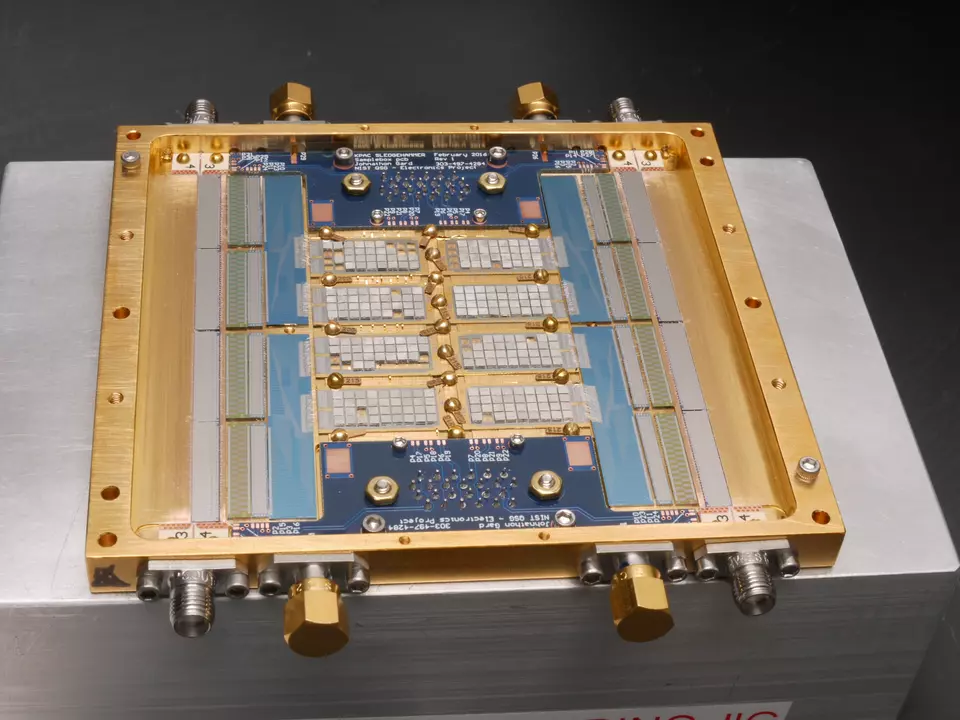
    An array of sensors appear as a set of rectangles within a gold-colored metal frame.

    Image shows an array of about 250 gamma-ray transition edge sensors developed at NIST and used in the new study.

    Credit:

    NIST
    To monitor the amount and type of nuclear material at power plants and weapons facilities, scientists look for a special signal — the unique pattern of gamma rays emitted by specific radioactive elements. However, some of these elements also emit X-rays in the same energy range as the gamma-ray emissions, masking the signal and making nuclear stockpiles harder to assess.

    Now, researchers at the National Institute of Standards and Technology (NIST) have measured the confounding X-ray emissions from plutonium, uranium and neptunium (a nuclear decay product of uranium) with unprecedented accuracy. This achievement allows scientists to filter out the X-ray background noise so they can more precisely evaluate the accumulation of nuclear materials. 

    “Our measurements support international nuclear safeguards by enabling more precise accounting of material in nuclear facilities,” said Jonathan Dean, a physicist at NIST and the University of Colorado Boulder.

    Dean and his colleagues, including researchers from NIST, the University of Colorado Boulder, the Los Alamos National Laboratory in New Mexico, Houghton University in New York and the Kastler Brossel Laboratory at Sorbonne University in Paris, reported their work in Physical Review Letters.

    To make the X-ray measurements, the team employed an array of quantum sensors developed at NIST, which act as miniature, exquisitely sensitive thermometers. These devices, known as transition edge sensors (TESs), consist of a superconducting film held at a temperature just a fraction of a degree above absolute zero. At this temperature, the film lies right at the transition region between a zero-resistance superconductor and an ordinary metal with measurable resistance. When an individual particle of light, such as an X-ray photon, strikes the sensor, it imparts a minuscule amount of heat — but just enough to sharply increase the resistance of the superconducting film.

    The resistance is directly proportional to the energy of the photon, enabling the sensor to make high-resolution energy measurements. The researchers measured the X-rays emitted by uranium, plutonium and neptunium in the energy range where they overlap with gamma-ray emissions. The sensitivity of the TES reduced the uncertainty of the X-ray energy measurements by one-third to one-eighth compared with previous measurements.

    Left: words reading "The gamma ray spectrum is like a barcode..." with a visual underneath of a hand holding a scanner like you'd see at a grocery store and it's scanning a bard code. MIDDLE: Word reading "poor resolution scanner likely mis-identification" showing a blurry bar code. RIGHT:  words reading "good resolution scanner reliable identification" with a clear barcode

    Transition edge sensors act like high-resolution scanners for precisely detecting the energies of X rays and gamma rays. The ultrasharp detail provided by the sensors enabled researchers at NIST and their colleagues to more clearly distinguish the X-ray and gamma-ray spectra from three radioactive elements.

    Credit:

    Jenny Wang / NIST

    By precisely measuring and effectively subtracting the obscuring X-ray radiation, TESs and other detectors that record gamma-rays can more accurately characterize nuclear materials. For instance, atoms of a single element can contain different numbers of neutrons in their nuclei — distinct forms called isotopes. Measuring the ratio between these isotopes is critical because it can indicate whether a material is intended for use in a nuclear power plant or a nuclear weapon. 

    For example, the isotope uranium-235 accounts for only 0.7% of the total abundance of uranium in nature but must be enriched to a relative abundance of a few percent for fuel and 90% for weapons-grade material. 

    In addition to having greater accuracy, the new measurements allow scientists to assess the composition of nuclear material more rapidly. Rapid assessments should come in handy at nuclear power plants, Dean said. Generating electricity from the heat unleashed by fissioning uranium atoms is a multistep process, and at each step the composition of the nuclear fuel must be reassessed before proceeding. Measuring the composition more quickly should shorten the hold-up time between steps and has the potential to increase efficiency and reduce costs at nuclear power plants.

    The sensors must be cooled to a fraction of a degree above absolute zero, and the necessary cooling equipment is too bulky to be handheld. However, arrays of TES detectors can operate at any location that has a source of electricity sufficient to power the refrigeration system. In other locations where a TES is not immediately available, scientists can take samples of the radioactive material and send them to a separate laboratory. “Our instruments are compatible with both approaches,” Dean said.

    How TES Devices Work
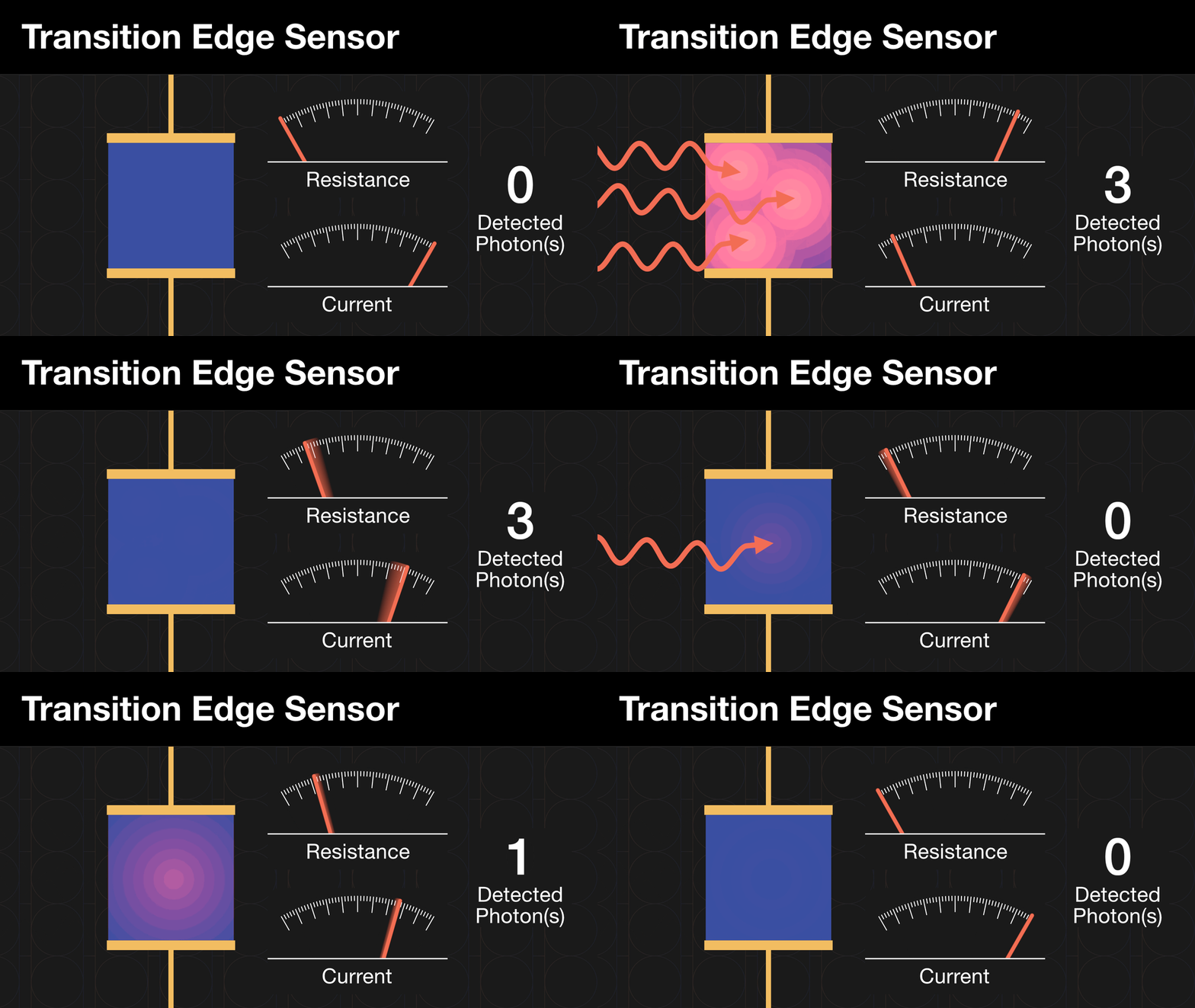
    Animated image of transition edge sensor shows photons as wiggly lines being detected via moving dials labeled "Resistance" and "Current."

    A transition-edge sensor can detect the number of photons hitting it. The energy deposited by one photon causes a small change in resistance and current. The energy of three photons triggers a larger change.

    Credit:

    S. Kelley/NIST

    In partnership with the Los Alamos National Laboratory, NIST scientists have installed TES detectors at three Department of Energy laboratories to monitor nuclear material at those sites. NIST has also deployed TES detectors for use in research projects at the SLAC National Accelerator Laboratory at Stanford University, the Advanced Photon Source synchrotron at Argonne National Laboratory, the National Synchrotron Light Source at Brookhaven National Laboratory and at several international facilities including the CERN particle accelerator in Switzerland.

    The team is now working on pushing the detectors’ accuracy to new levels to aid in the search for new types of fundamental particles in collaboration with CERN and to install a new detector at NASA Goddard to help understand the most extreme environments in our universe.

    In addition, NIST is working to simplify, miniaturize and reduce the cost of the equipment for chilling the sensors. Two U.S. companies have adapted and now manufacture a NIST-designed compact refrigeration system for the TESs. 


    Paper: A. Wessels, et al. Measured and theoretical Kα x-ray emission linewidths of U, Np, and Pu. Physical Review Letters. Published online Sept. 10, 2026. DOI: 10.1103/tcbz-kqk1

    Improve Monitoring NISTDeveloped Nuclear Quantum sensors
    Share. Facebook Twitter Pinterest LinkedIn Tumblr Email
    admin
    • Website

    Related Posts

    Hugging Face partners with Wiz Research to Improve AI Security

    November 12, 2026

    Nvidia is reportedly preparing to fire Jensen Huang

    November 11, 2026

    IBM to offer access to a dual-processor quantum system in 2027

    November 11, 2026
    Leave A Reply Cancel Reply

    Top Posts

    NVIDIA Is Investigating Reports That CEO Jensen Huang Was The Target Of Chinese Spy Efforts

    November 8, 202619 Views

    Anthropic releases new Mythos and Fable models amid RSI concerns

    November 9, 20265 Views

    Efficient Vision-Language-Action Model trained on Lerobot Community Data

    November 10, 20264 Views

    Does a Trading Policy Need to Know What It Trades? Microstructure Invariance and Zero-Shot Transfer of Execution Policies

    November 9, 20264 Views
    Don't Miss
    Gadgets & Smart Devices

    Rocco Super Smart Fridge Review: A Cool Conversation Piece

    By adminNovember 12, 20260

    Nutrition facts also pop up for each drink, although many of them are incomplete. In…

    Text2SQL using Hugging Face Dataset Viewer API and Motherduck DuckDB-NSQL-7B

    November 12, 2026

    Google Wanted Spirit Airlines Data. Flight Attendants Found a Way to Opt Out

    November 12, 2026

    Australia’s proposed AI safety bill would force frontier model makers to open up to independent testing

    November 12, 2026
    About Us

    Welcome to TechWave Dispatch

    At TechWave Dispatch, we bring you the latest news, insights, and developments from the ever-evolving world of technology. Our mission is to keep readers informed about the innovations shaping our digital future.

    From artificial intelligence and machine learning to cybersecurity, robotics, smart devices, and groundbreaking technologies, we cover the topics that matter in today's fast-moving tech landscape.

    Our Picks

    Rocco Super Smart Fridge Review: A Cool Conversation Piece

    November 12, 2026

    Text2SQL using Hugging Face Dataset Viewer API and Motherduck DuckDB-NSQL-7B

    November 12, 2026

    Google Wanted Spirit Airlines Data. Flight Attendants Found a Way to Opt Out

    November 12, 2026
    Most Popular

    Who Controls Scientific Discovery? – O’Reilly

    November 6, 20260 Views

    After blocking Muse, Amazon now lets users text Alexa to help them shop

    November 6, 20260 Views

    A controlled world for robot learning and evaluation

    November 6, 20260 Views
    Facebook X (Twitter) Instagram Pinterest
    • Terms and Conditions
    • Privacy Policy
    • Contact Us
    • About Us
    © 2026 TechWave Dispatch. All Rights Reserved.

    Type above and press Enter to search. Press Esc to cancel.