


Credit:
NIST
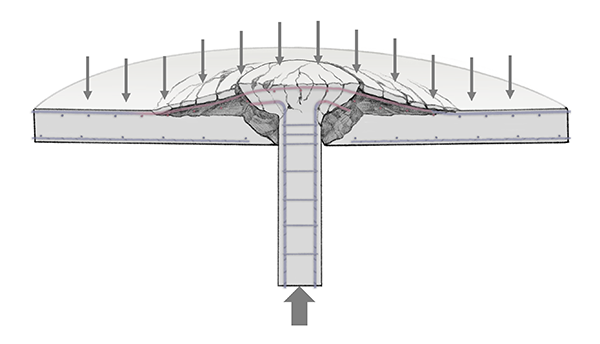
Today the National Institute of Standards and Technology’s National Construction Safety Team released its technical findings on the cause of the partial collapse of the Champlain Towers South building on June 24, 2021, which took the lives of 98 people. Following an extensive technical investigation, the team has concluded that the collapse began in early June 2021, when two connections between garage columns and the pool deck failed. These initial column failures caused cracks to grow and loads to redistribute in the pool deck over the next three weeks, resulting in the transfer of their loads to adjacent slab-column connections that were not strong enough to support them. This led to the larger catastrophic collapse on June 24.
Investigation co-leads Judith Mitrani-Reiser and Glenn Bell explain the findings in a video presentation released today. The video includes a high-level introduction to the findings, followed by detailed technical explanations with visualizations, photographs and animations.
NCST Champlain Towers South Investigation | Technical Findings (June 2026)
“When building structures are designed and built to required codes and standards, they have margins against failure, meaning they should be able to support much more load than they are expected to bear,” said Mitrani-Reiser. “In the case of Champlain Towers South, however, these margins against failure were too narrow from the start.”
Champlain Towers South was built in 1981 on the Atlantic coast in Surfside, Florida. It stood 12 stories high, plus a penthouse, and comprised three sections, which the NIST team refers to as the West, Middle and East parts.
Based on the evidence and the principles of structural mechanics used to assess the building, the team believes the following scenario is most likely to have happened on June 24, 2021, weeks after the failure of the initial two columns: The failure spread to other elements of the pool deck and street-level parking structure, eventually unseating the southern edge of the pool deck slab from a supporting wall. This caused the slab to sag further and eventually break away at its northern edge from the face of the middle part of the tower. When the pool deck slab broke away, it damaged two connections supporting that part of the tower. The failure then progressed through the Middle part of the tower, followed by the East part.
“The low margins against failure were primarily caused by two factors,” explained Bell. “First, severe and widespread deviations in the building’s original structural design from the codes and standards of the day, but also some limitations in those codes and standards. And second, deviations in the building’s construction from the design drawings.”
Loads added to the structure over its lifetime — including pool deck modifications described in a previous investigation update — further diminished the margins against failure, as did long-term degradation from corrosion.
In the video, Bell also lists factors that the investigation has ruled out as contributing to the failure, including vibrations from nearby construction; foundation failure, sinkholes or settling; hurricane and storm surge effects; impulsive loads (e.g., weight dropped from a crane or explosion); and accidental overloads caused by a roof project underway at the time of the collapse.
The Investigation
NIST’s investigation into the cause of the collapse began just days after the tragedy. The fact that the building had stood for 40 years and then collapsed for no immediately apparent reason made the investigation particularly challenging. The team examined two dozen possible scenarios for where and why the collapse started. Its experts systematically evaluated each one by analyzing physical evidence and historical records; conducting extensive interviews with survivors and those familiar with the building; performing materials testing and geotechnical studies; constructing and testing building components like those within CTS; and creating computer models of the collapse. Throughout the investigation, NIST released preliminary findings and updates on its progress.
Today NIST also released a new NCST Insider video, featuring Ken Hover, co-lead of the investigation’s materials science project. In the video, he describes the difficulty of recreating concrete that matched what was used in the original building and the importance of getting it right. The entire NCST Insider series offers insights into each of the investigation’s projects and how team members approached their work.
NCST Insider | feat. Ken Hover
The investigation relied on NIST’s ability to bring together experts in historic construction codes and practices; evidence preservation; forensic chemistry; social science; remote sensing and data visualization; materials science; and structural and geotechnical engineering. It also benefited from NIST’s extensive experience in building strong relationships with other organizations to support technical collaborations. For example, immediately following the collapse, NIST worked closely with first responders to ensure that potential evidence could be preserved without interfering with the search and rescue operations.
“This challenging investigation could not have been conducted without the support of experts within Florida and across the U.S., as well as people familiar with the building and its history,” said Mitrani-Reiser.
“We appreciate everyone who has helped with this work, including the survivors and the families of those who were lost,” said Bell. “With their invaluable input, this effort will help make other buildings safer, help prevent tragedies like this from happening again and help honor the lives of the Champlain Towers South victims.”
The team will now focus on writing its final report, which will include all the evidence analysis, test results and computational modeling to support the findings released today. The report will also include recommendations for changes to standards, codes and practices, as well as additional research that might be needed, and will serve as a road map as NIST works with others to improve building safety.
