


Open AI’s Whisper is a general
purpose speech transcription model that achieves state-of-the-art results across a range of different benchmarks and
audio conditions. The latest large-v3 model tops the
OpenASR Leaderboard, ranking as the best open-source
speech transcription model for English. The model also demonstrates strong multilingual performance, achieving less than
30% word error rate (WER) on 42 of the 58 languages tested in the Common Voice 15 dataset.
While the transcription accuracy is exceptional, the inference time is very slow. A 1 hour audio clip takes upwards of
6 minutes to transcribe on a 16GB T4 GPU, even after leveraging inference optimisations like flash attention,
half-precision, and chunking.
In this blog post, we demonstrate how Speculative Decoding can be employed to reduce the
inference time of Whisper by a factor of 2, while mathematically ensuring exactly the same outputs are achieved
from the model. As a result, this method provides a perfect drop-in replacement for existing Whisper pipelines, since it
provides free 2x speed-up while maintaining the same accuracy. For a more streamlined version of the blog post
with fewer explanations but all the code, see the accompanying Google Colab.
Speculative Decoding
Speculative Decoding was proposed in Fast Inference from Transformers via Speculative Decoding
by Yaniv Leviathan et. al. from Google. It works on the premise that a faster, assistant model very often generates the same tokens as a larger main model.
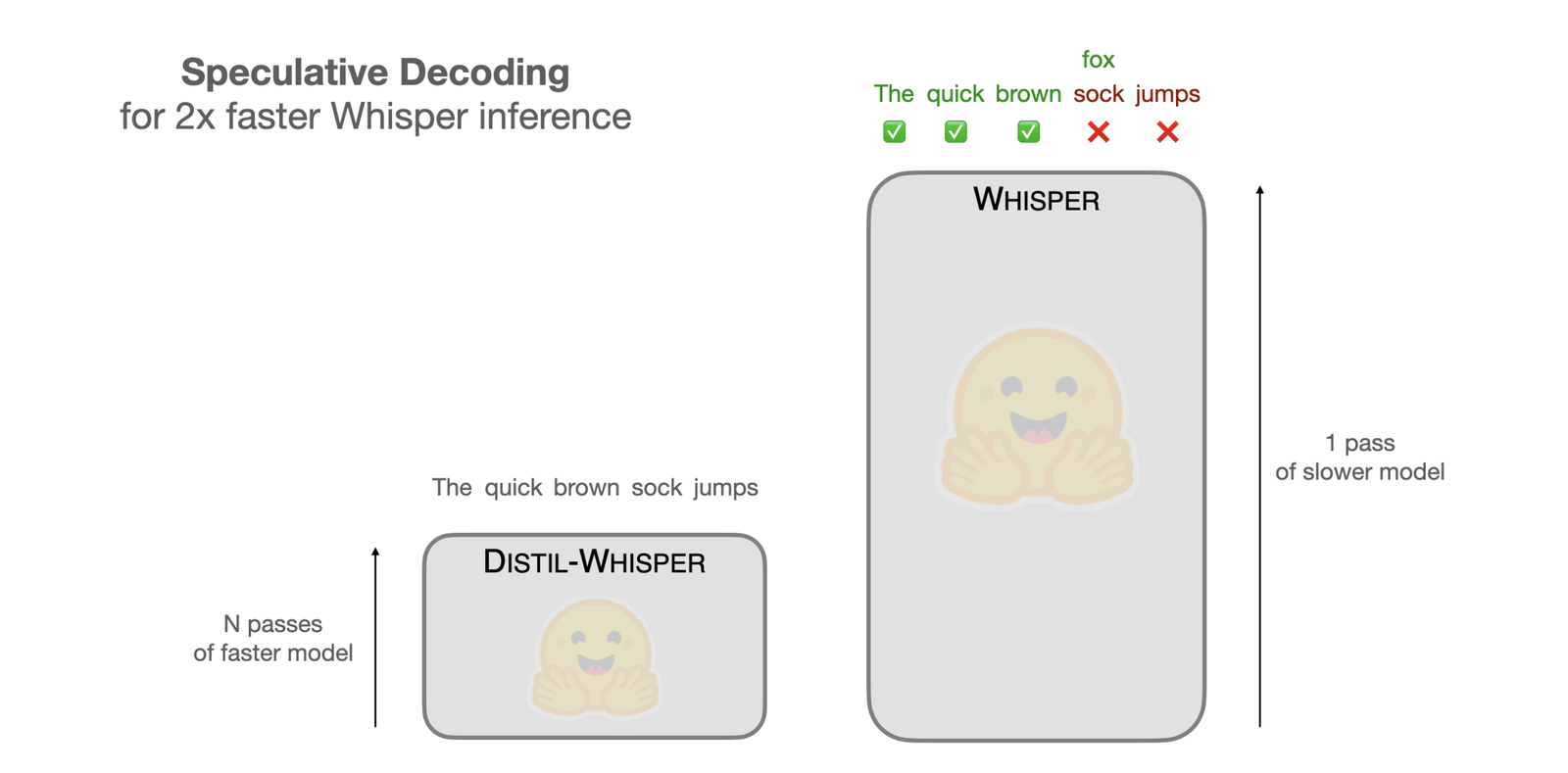
First, the assistant model auto-regressively generates a sequence of candidate tokens, .
In the diagram below, the assistant model generates a sequence of 5 candidate tokens: The quick brown sock jumps.
While these candidate tokens are generated quickly, they may differ from those predicted by the main model. Therefore,
in the second step, the candidate tokens are passed to the main model to be “verified”. The main model takes the
candidate tokens as input and performs a single forward pass. The outputs of the main model are the “correct”
token for each step in the token sequence .
In the diagram above, we see that the first three tokens predicted by the main model agree with those from the assistant
model: The quick brown. However, the fourth candidate token from the assistant model,
sock, mismatches with the correct token from the main model, fox.
We know that all candidate tokens up to the first mismatch are correct (The quick brown),
since these agree with the predictions from the main model. However, after the first mismatch, the candidate tokens
diverge from the actual tokens predicted by the main model. Therefore, we can replace the first incorrect candidate
token (sock) with the correct token from the main model (fox),
and discard all predicted tokens that come after this, since these have diverged. The corrected sequence, The quick brown fox,
now forms the new input to the assistant model:
The inference process then repeats, the assistant model generating a new set of candidate tokens, which are verified
in a single forward pass by the main model.
Since we auto-regressively generate using the fast, assistant model, and only perform verification forward passes with
the slow, main model, the decoding process is sped-up substantially. Furthermore, the verification forward passes
performed by the main model ensures that exactly the same outputs are achieved as if we were using the main model standalone.
This makes speculative decoding a perfect drop-in for existing Whisper pipelines, since one can be certain that the
same quality will be attained.
To get the biggest improvement in latency, the assistant model should be significantly faster than the main model,
while predicting the same token distribution as often as possible. In practice, these two attributes form a trade-off:
the faster a model is, the less accurate it is. However, since 70-80% of all predicted tokens tend to be “easier” tokens,
this trade-off is heavily biased towards selecting a faster model, rather than a more accurate one. Thus, the assistant
model should be at least 3x faster than the main model (the more the better), while predicting all the “easy” tokens
in the examples correctly. The remaining 20-30% of more “difficult” tokens can then be verified by the larger, main model.
The only constraint for selecting an assistant model is that it must share the same vocabulary as the main model. That is
to say, the assistant model must use one-to-one the same tokenizer as the main model.
Therefore, if we want to use speculative decoding with a multilingual variant of Whisper, e.g. large-v2
(multilingual), we need to select a multilingual variant of Whisper as the assistant model, e.g. tiny.
Whereas, if we want to use speculative decoding with and English-only version of Whisper, e.g. medium.en,
we need an English-only of version as the assistant model, e.g. tiny.en.
At the current time, Whisper large-v3 is an exception, since
it is the only Whisper checkpoint with an expanded vocabulary size, and thus is not compatible with previous Whisper
checkpoints.
Now that we know the background behind speculative decoding, we’re ready to dive into the practical implementation. In
the 🤗 Transformers library, speculative decoding is implemented as
the “assisted generation” inference strategy. For more details about the implementation, the reader is advised to read
Joao Gante’s excellent blog post on Assisted Generation.
English Speech Transcription
Baseline Implementation
We start by benchmarking Whisper large-v2 to get our baseline number
for inference speed. We can load the main model and it’s corresponding processor via the convenient
AutoModelForSpeechSeq2Seq
and AutoProcessor classes. We’ll
load the model in float16 precision and make sure that loading time takes as little time as possible by passing
low_cpu_mem_usage=True. In addition,
we want to make sure that the model is loaded in safetensors
format by passing use_safetensors=True.
Finally, we’ll pass the argument attn_implementation="sdpa" to benefit from Flash Attention speed-ups through PyTorch’s
SDPA attention kernel:
import torch
from transformers import AutoModelForSpeechSeq2Seq, AutoProcessor

device = "cuda:0" if torch.cuda.is_available() else "cpu"
torch_dtype = torch.float16 if torch.cuda.is_available() else torch.float32

model_id = "openai/whisper-large-v2"

model = AutoModelForSpeechSeq2Seq.from_pretrained(
    model_id,
    torch_dtype=torch_dtype,
    low_cpu_mem_usage=True,
    use_safetensors=True,
    attn_implementation="sdpa",
)
model.to(device)

processor = AutoProcessor.from_pretrained(model_id)
Let’s load the English speech transcription dataset that we will use for benchmarking. We’ll load a small dataset
consisting of 73 samples from the LibriSpeech ASR validation-clean
dataset. This amounts to ~9MB of data, so it’s very lightweight and quick to download on device:
from datasets import load_dataset

dataset = load_dataset("hf-internal-testing/librispeech_asr_dummy", "clean", split="validation")
For the benchmark, we only want to measure the generation time, so let’s write a short helper function that measures
this step. The following function will return both the decoded tokens and the time it took to run the model:
import time

def generate_with_time(model, inputs, **kwargs):
    start_time = time.time()
    outputs = model.generate(**inputs, **kwargs)
    generation_time = time.time() - start_time
    return outputs, generation_time
We can now iterate over the audio samples in our dataset and sum up the overall generation time:
from tqdm import tqdm

all_time = 0
predictions = []
references = []

for sample in tqdm(dataset):
    audio = sample["audio"]
    inputs = processor(audio["array"], sampling_rate=audio["sampling_rate"], return_tensors="pt")
    inputs = inputs.to(device=device, dtype=torch.float16)

    output, gen_time = generate_with_time(model, inputs)
    all_time += gen_time
    predictions.append(processor.batch_decode(output, skip_special_tokens=True, normalize=True)[0])
    references.append(processor.tokenizer._normalize(sample["text"]))

print(all_time)
Output:
100%|██████████| 73/73 [01:37<00:00,  1.33s/it]
72.99542546272278
Alright! We see that transcribing the 73 samples took 73 seconds. Let’s check the WER of the predictions:
from evaluate import load

wer = load("wer")
print(wer.compute(predictions=predictions, references=references))
Output:
0.03507271171941831
Our final baseline number is 73 seconds for a WER of 3.5%.
Speculative Decoding
Now let’s load the assistant model for speculative decoding. In this example, we’ll use a distilled variant of Whisper,
distil-large-v2. The distilled model copies the entire encoder
from Whisper, but only 2 of the 32 decoder layers. As such, it runs 6x faster than Whisper, while performing to within
1% WER on out-of-distribution test sets. This makes it the perfect choice as an assistant model, since it has both
high transcription accuracy and fast generation .
Since Distil-Whisper uses exactly the same encoder as the Whisper model, we can share the encoder across the main and
assistant models. We then only have to load the 2-layer decoder from Distil-Whisper as a “decoder-only” model. We can do
this through the convenient AutoModelForCausalLM
auto class. In practice, this results in only an 8% increase to VRAM over using the main model alone.
from transformers import AutoModelForCausalLM

assistant_model_id = "distil-whisper/distil-large-v2"

assistant_model = AutoModelForCausalLM.from_pretrained(
    assistant_model_id,
    torch_dtype=torch_dtype,
    low_cpu_mem_usage=True,
    use_safetensors=True,
    attn_implementation="sdpa",
)

assistant_model.to(device)
We intend to release an improved variant of Distil-Whisper with a stronger alignment in the token distribution
that will improve speculative decoding performance further. Follow the Distil-Whisper repository
for updates.
We can define a modified function for our speculative decoding benchmark. The only difference from the previous function
is that we pass the assistant model to our call to .generate:
def assisted_generate_with_time(model, inputs, **kwargs):
    start_time = time.time()
    outputs = model.generate(**inputs, assistant_model=assistant_model, **kwargs)
    generation_time = time.time() - start_time
    return outputs, generation_time
Let’s run the benchmark with speculative decoding, using Distil-Whisper as the assistant to Whisper:
all_time = 0
predictions = []
references = []

for sample in tqdm(dataset):
    audio = sample["audio"]
    inputs = processor(audio["array"], sampling_rate=audio["sampling_rate"], return_tensors="pt")
    inputs = inputs.to(device=device, dtype=torch.float16)

    output, gen_time = assisted_generate_with_time(model, inputs)
    all_time += gen_time
    predictions.append(processor.batch_decode(output, skip_special_tokens=True, normalize=True)[0])
    references.append(processor.tokenizer._normalize(sample["text"]))

print(all_time)
Outputs:
100%|██████████| 73/73 [00:38<00:00,  1.88it/s]
32.69683289527893
With speculative decoding, the inference time was just 33 seconds, 2.2x faster than before! Let’s verify we have the same
WER:
print(wer.compute(predictions=predictions, references=references))
Outputs:
0.03507271171941831
Perfect! 3.5% WER again, as we have identical outputs to using the main model standalone.
Speculative decoding can also be used with the easy 🤗 Transformers pipeline API for inference. Below, we instantiate the pipeline using the model and processor, and then use it to
transcribe the first sample from the toy dataset. This can be extended to transcribe audio samples of arbitrary length,
including with the use of batching:
from transformers import pipeline

pipe = pipeline(
    "automatic-speech-recognition",
    model=model,
    tokenizer=processor.tokenizer,
    feature_extractor=processor.feature_extractor,
    max_new_tokens=128,
    chunk_length_s=15,
    batch_size=4,
    generate_kwargs={"assistant_model": assistant_model},
    torch_dtype=torch_dtype,
    device=device,
)

sample = dataset[0]["audio"]
result = pipe(sample)
print(result["text"])
Outputs:
Mr. Quilter is the apostle of the middle classes and we are glad to welcome his gospel.
An end-to-end code snippet for running speculative decoding with Whisper and Distil-Whisper can be found on the Distil-Whisper model card.
It combines the stages of inference covered in this notebook into a single code example.
Multilingual Speech Transcription
Distil-Whisper is the perfect assistant model for English speech transcription, since it performs to within 1% WER of the
original Whisper model, while being 6x faster over short and long-form audio samples. However, the official Distil-Whisper
checkpoints are English only, meaning they cannot be used for multilingual speech transcription.
To use speculative decoding for multilingual speech transcription, one could either use one of the official multilingual Whisper checkpoints,
or a fine-tuned variant of Whisper. At the time of writing, there are over 5,000 fine-tuned Whisper checkpoints
on the Hugging Face Hub in over 100 languages. These provide an excellent starting point for selecting assistant Whisper
checkpoints that perform very well on a single language. In this example, we’ll use the smallest official multilingual
checkpoint, Whisper tiny. Feel free to experiment with different checkpoints
fine-tuned in your language!
Let’s load the weights for our new assistant model, Whisper tiny. Since the encoder in Whisper tiny differs from that in
large-v2, this time we’ll load both the encoder and decoder using the AutoModelForSpeechSeq2Seq class:
assistant_model_id = "openai/whisper-tiny"

assistant_model = AutoModelForSpeechSeq2Seq.from_pretrained(
    assistant_model_id,
    torch_dtype=torch_dtype,
    low_cpu_mem_usage=True,
    use_safetensors=True,
    attn_implementation="sdpa",
)

assistant_model.to(device);
For our benchmarking dataset, we’ll load 73 samples from the Dutch (“nl”) split of the VoxPopuli dataset:
dataset = load_dataset("sanchit-gandhi/voxpopuli_dummy", "nl", split="validation")
Great! We can now re-run our benchmark for our baseline Whisper large-v2 model as before. The only change we make is that
we pass the language and task arguments to our generate function, in order to ensure we perform speech transcription
(not speech translation). Speculative decoding is fully compatible with both the speech transcription and translation tasks. Simply
set the task argument as required below:
all_time = 0
predictions = []
references = []

for sample in tqdm(dataset):
    audio = sample["audio"]
    inputs = processor(audio["array"], sampling_rate=audio["sampling_rate"], return_tensors="pt")
    inputs = inputs.to(device=device, dtype=torch.float16)

    output, gen_time = generate_with_time(model, inputs, language="nl", task="transcribe")
    all_time += gen_time
    predictions.append(processor.batch_decode(output, skip_special_tokens=True, normalize=True)[0])
    references.append(processor.tokenizer._normalize(sample["normalized_text"]))

wer_result = wer.compute(predictions=predictions, references=references)

print("Time:", all_time)
print("WER:", wer_result)
Outputs:
100%|██████████| 73/73 [02:05<00:00,  1.72s/it]
Time: 116.50992178916931
WER: 0.127190136275146
Right! We have our baseline time of 117 seconds and a WER of 12.8%. Let’s re-run the generation process using speculative decoding:
all_time = 0
predictions = []
references = []

for sample in tqdm(dataset):
    audio = sample["audio"]
    inputs = processor(audio["array"], sampling_rate=audio["sampling_rate"], return_tensors="pt")
    inputs = inputs.to(device=device, dtype=torch.float16)

    output, gen_time = assisted_generate_with_time(model, inputs, language="nl", task="transcribe")
    all_time += gen_time
    predictions.append(processor.batch_decode(output, skip_special_tokens=True, normalize=True)[0])
    references.append(processor.tokenizer._normalize(sample["normalized_text"]))

wer_result = wer.compute(predictions=predictions, references=references)

print("Time:", all_time)
print("WER:", wer_result)
Outputs:
100%|██████████| 73/73 [01:08<00:00,  1.06it/s]
Time: 62.10229682922363
WER: 0.127190136275146
Again, we achieve 12.8% WER, but this time in just 62 seconds of inference time, representing a speed-up of 1.9x.
Given the low overhead of loading the assistant model and the mathematical property that exactly the same outputs are
achieved, speculative decoding offers the perfect drop-in replacement to existing Whisper pipelines.
Strategies for Efficient Speculative Decoding
In this final section, we cover two strategies for ensuring the fastest possible inference time with speculative decoding.
Assistant Model
Our objective is to select an assistant model that is at least 3x faster than the main model and transcribes at least
70-80% of the predicted tokens correctly, typically the “easier” tokens in the examples. If you have a particular
language in which you want to transcribe, an effective strategy is to train two Whisper models of different sizes, and
use one as the assistant to the other:
- First, fine-tune Whisper large-v3 to act as your main model
- Second, distil Whisper large-v3 on the same dataset to act as a fast assistant model
Fine-tuning and distillation can improve the WER performance of both the main and assistant models on your chosen language,
while maximising the alignment in the token distributions. A complete guide to Whisper fine-tuning can be found
here, and distillation here.
Batch Size
It is worth noting that the largest speed gains with speculative decoding come with a batch size of 1. For batched
speculative decoding, all candidate tokens across the batch must match the validation tokens in order for the tokens
to be accepted. If a token in the batch at a given position does not agree, all candidate tokens that proceed the position
are discarded. Consequently, speculative decoding favours lower batch sizes. In practice, we find that speculative decoding
provides a speed-up until a batch size of 4. Above batch size 4, speculative decoding returns slower inference than the
main model alone. For full results, refer to Section D.3 of the Distil-Whisper paper.
Conclusion
In this blog post, we covered the inference strategy of speculative decoding, as applied to the Whisper model for speech
transcription. We demonstrated how 2x speed-ups can be achieved, while mathematically ensuring the same outputs as using
the original model alone. We encourage you to try speculative decoding as a drop-in replacement for existing Whisper
pipelines, given the low overhead of using the additional assistant model and the guarantee of the same transcription results.
Acknowledgements
Blog post by Sanchit Gandhi. Many thanks to Patrick von Platen
and Pedro Cuenca for their constructive comments, and to Joao Gante
for the assisted generation implementation in 🤗 Transformers.
