

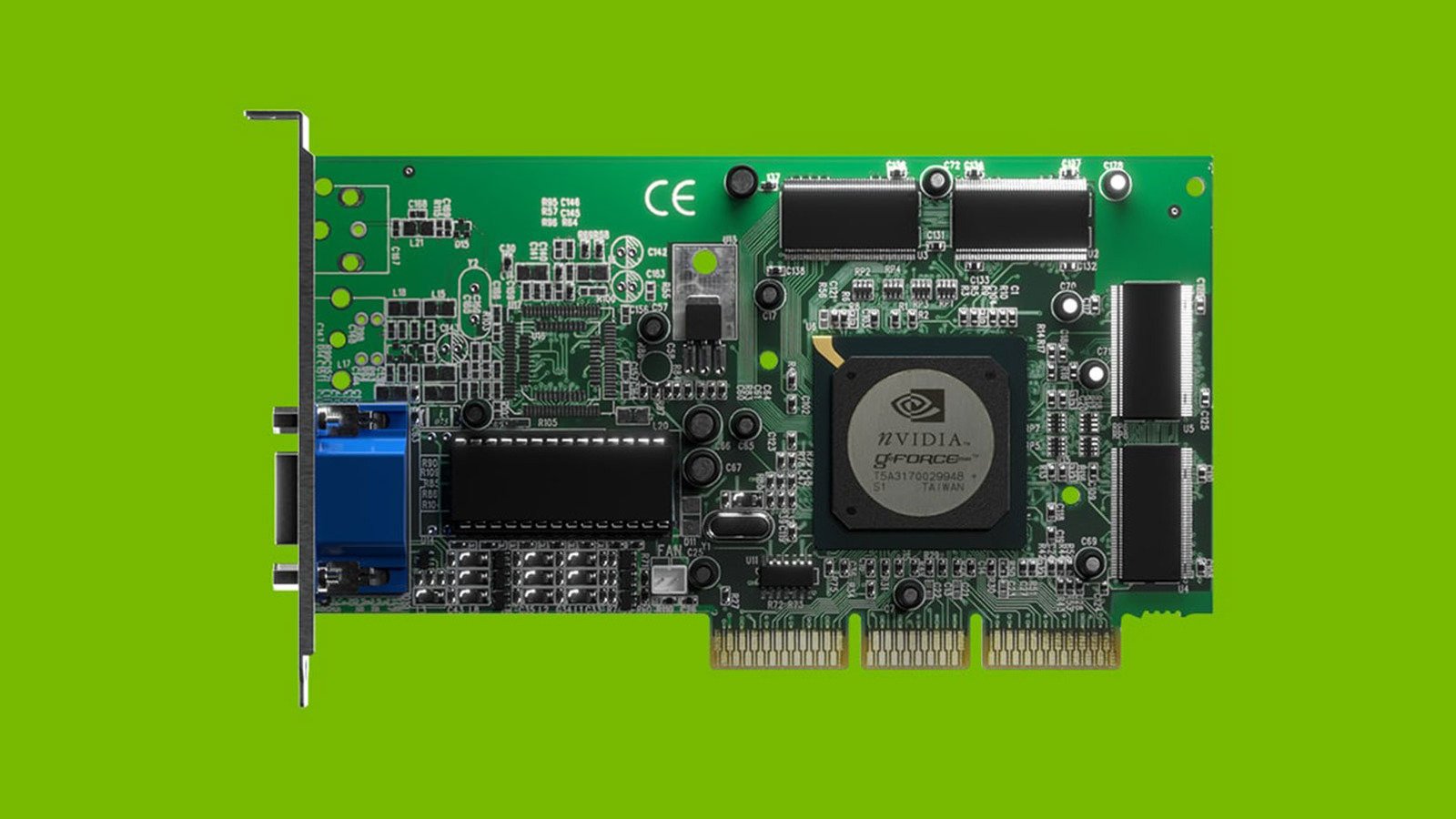
With the GeForce 256, NVIDIA built a 3D card for the future.
The year is 1999. The Wachowskis release The Matrix in March of that year, and Y2K is all anyone can seem to talk about. It’s also the year that NVIDIA debuts its first GeForce product, the GeForce 256. Judged against the standards of modern video cards, the 256 doesn’t seem so special. It only had a modest 17 million transistors and up to 64MB of memory, depending on the specific model. To put those specs in perspective, even the entry-level GeForce RTX 5050 has it beat, with 16.9 billion transistors and 8GB of VRAM.
But the GeForce 256 was special. Besides being the first NVIDIA product to carry the GeForce name, the company also marketed it as the world’s first graphics processing unit (GPU). We’ll get to what that means in a moment, but looking back now, it was a decision that would change NVIDIA and the industry forever.
The PC gaming industry in 1999
With NVIDIA controlling as much as 95 percent of the gaming GPU market in recent years, it’s easy to forget that the PC landscape was very different in 1999. At the time, the company was one of three major players in the market alongside 3dfx and ATI Technologies. The dominant force was 3dfx, with its Voodoo line of 3D accelerators. AMD had not yet bought ATI, and wouldn’t for almost seven more years. However, 1999 was also the year that the market that we know today began to take shape.
While 3dfx was still the market leader, NVIDIA had begun to chip away at the company’s position, starting with the release of its RIVA TNT graphics card in 1998. The TNT 2, released in early 1999, was another strong release from NVIDIA, followed later that year by the GeForce 256. The GeForce 256 first arrived on October 11, just a few short weeks after the official release of DirectX 7.0 in late September. As a result, the 256 was the first video card to fully support Microsoft’s new API, alongside the hardware transform and lighting (T&L) capabilities it added to Windows.
Graphics accelerators and GPUs
If you bought a 3D card before the GeForce 256, what you were buying was a graphics “accelerator.” It would work alongside your processor to render 3D games, with the CPU handling the front half of the graphics pipeline. That meant it would “transform” 3D objects by moving their geometry in front of the game’s camera and then calculating how light affects each vertex. It would then hand off the workload to your computer’s 3D accelerator for it to texture and shade those objects. The GeForce 256 could handle that entire process from start to finish.
In an era where ray tracing is slowly becoming the norm, we take hardware T&L for granted, but once games started to take advantage of the technology, polygon budgets exploded, allowing for far more realistic and detailed 3D graphics.
NVIDIA realized how transformative this technology would be for gaming, and marketed the GeForce 256 accordingly. Other companies had dabbled with hardware T&L or did parts of it before NVIDIA, but the company was the first to bring it all together in a single consumer product. By describing the GeForce 256 and every GeForce card that came after as GPUs, the company communicated to consumers that its video cards were just as important for gaming as the CPUs in their computers.
3dfx’s failure to release a hardware T&L-capable graphics card contributed to the company’s demise and NVIDIA buying most of its assets in December 2000. ATI avoided that same fate by releasing its first Radeon GPU in 2000.
The Max Payne advantage
Legacy aside, how did the GeForce 256 perform? Looking back at benchmarks from that era, the reason to buy the world’s first GPU was its performance in games like Quake 3 Arena and Unreal Tournament, which arrived within a few weeks of each other at the end of that year.
In testing by Tom’s Hardware, the GeForce 256 DDR — NVIDIA sold Single Data Rate (SDR) and Double Data Rate (DDR) variants of the card — trounced the competition. With the 32-bit color depth setting enabled, the GeForce 256 DDR would render the game’s demo at an average of 72.1 frames per second at 1,024 by 768. By comparison, the best non-GeForce offering was the Creative Labs TNT2 Ultra, which averaged 44.8 frames per second at the same resolution. If you had a 3dfx card like the Voodoo3 3000, you had to play the game in 16-bit color, since the company didn’t design the Voodoo 3 family with 32-bit color support in mind.
If you were lucky enough to own a GeForce 256 back in 1999, you felt like a prophet when Remedy Entertainment released Max Payne in 2001. It was one of the first games to be built from the ground up with hardware T&L rendering in mind. And while you could play the game with an older 3D accelerator, a proper GPU like the GeForce 256 meant the difference between a playable framerate and a slideshow. With the game set at 1,024 by 768 and a 16-bit color depth, the GeForce 256 could render an average of 35 frames per second. I know that doesn’t sound impressive, but remember this was an era when PC hardware was advancing rapidly, thanks to growing transistor counts. Being able to play a game like Max Payne on a nearly three-year-old graphics card was a miracle, and it’s all because NVIDIA had the foresight to build it for the future.
