

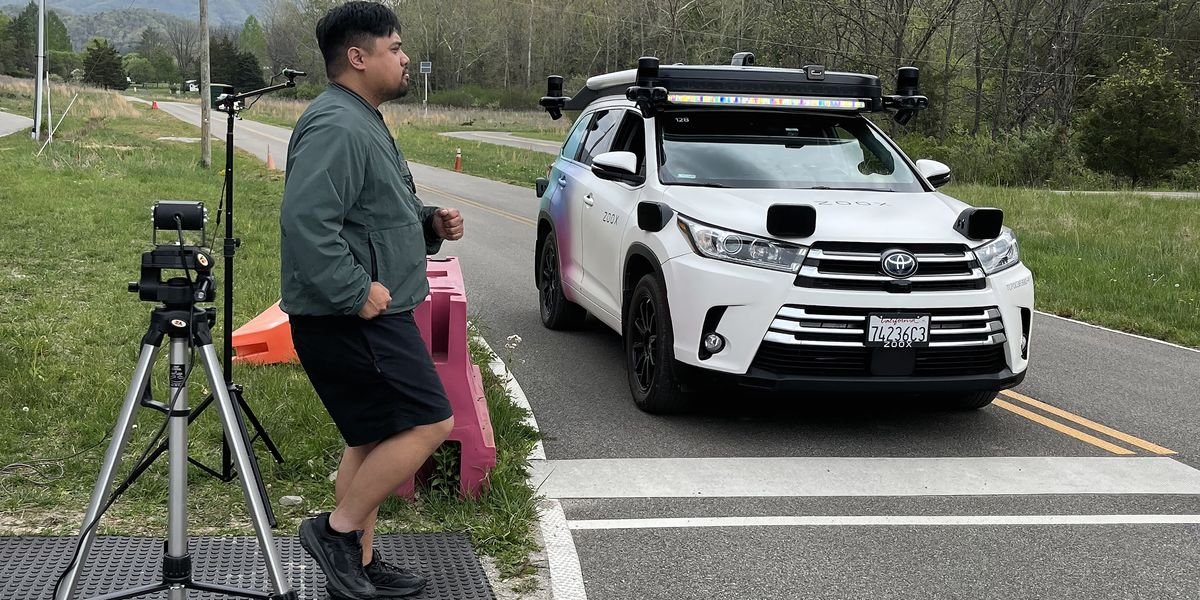
How can a blind pedestrian at an intersection know that the stopped autonomous car in front of them has no driver? Sighted pedestrians can see the empty driver’s seat. A blind or low vision pedestrian often has only sound cues to go on.
According to a recent study from the Foster City, Calif.-based company Zoox and Virginia Tech University in Blacksburg, Va., the audio cues that a car uses to communicate with visually impaired pedestrians matter. A traditional car horn can startle a blind pedestrian who’s not expecting it, researchers found. So instead the researchers tested a range of alternative sounds for the car that were equally as effective as a car horn.
“It is a unique sound in an environment where people are expecting a horn,” says research scientist Shelia Klauer from the Virginia Tech Transportation Institute of the sonic alerts the team tested. “And therefore it contains a certain salience to it.”
According to Zoox researcher Yang, the research vehicles featured two 32-channel speaker arrays capable of beaming bidirectional pedestrian audio. The speaker arrays would allow the car to aim its alert sounds at pedestrians to ensure each listener knows where the alert sound is coming from.
According to a recent Zoox blog on the research, the sounds themselves are a “mix of chimes and voice cues.” The car’s horn has mutiple sounds, depending on the situation and the alert message the car is trying to convey. The cars use a louder horn, the post noted, for communicating with drivers in other vehicles. By contrast, it uses a friendlier horn tone for pedestrians, as well as a rear-directed one to help prevent rear-end collisions.
“Previous research has been focused on creating different types of visual displays on vehicles to communicate with pedestrians,” says Klauer. “We were focused on auditory [cues]—which there’s very few studies about—in an actual, real world environment.”
How Autonomous Cars Can Signal It’s Safe to Cross
The researchers tested a range of “alert” tones—attempting to sonically discourage a pedestrian from crossing—as well as waiting tones, meant to sound as if the car was signalling the pedestrian that it’s safe to cross.
Testing more than 350 jaywalking and crossing-at-the-crosswalk scenarios, the researchers found the “alert” tones discouraged pedestrians intending to jaywalk. On the other hand, the cars’ waiting tones, the researchers found, did not signal anything to pedestrians. Pedestrians were just as likely to cross—and crossed just as promptly—without the waiting tones as with.
The alert tones, says Klauer, were as effective as a horn at influencing pedestrians’ decisions not to cross.
Yang, senior staff sound designer at Zoox, says both alert and waiting tones were tricky to get right. “Interestingly, we found that some sounds people might confuse with, say, a sound of an animal,” he says. “Maybe a sound sounded a bit too cute.”
Yang adds the researchers were careful not to develop a sound that sounded “too futuristic or abstract,” ensuring it was unique but still associated with a vehicle.
Although design of autonomous car sounds have been tested and studied for years, the Zoox/Virginia Tech study was one of the first to test each alert sound in a real-world environment, with researchers studying users’ auditory perceptions and reactions. Designing a study to include and center experiences of visually impaired users makes the research more unique still.
Engineers developing automated-vehicle technology clearly need to focus on inclusivity. Visually impaired pedestrians and riders may face several difficulties when hailing an autonomous driverless vehicle without a sighted companion. Some difficulties include identifying the correct vehicle, pickup-location mismatches, and quiet electric motors. Apps often show a license plate or a color on the screen to identify the vehicle that has been assigned to a rider. A blind or low-vision person may not be able to read the license plate or identify the color, and several identical vehicles may be waiting. A vehicle may stop at a location that is different from where the person is waiting. And without a driver to say, “I’m over here,” that person may not know their ride has arrived. The same quiet electric motors that make vehicles hard to hear on the street also make them hard to find at the curb.
“We have to design the transportation system for all of its users, and that includes low-vision and blind pedestrians,” Klauer says. “It includes pedestrians with other disabilities. Being able to design these vehicles for everyone is one of the big benefits of automated vehicles, and we can’t lose sight of that.”
This article was supported by the IEEE Foundation and a Jon C. Taenzer fellowship grant.
From Your Site Articles
Related Articles Around the Web
